Creative Strategy Archives - Pixated

The anatomy of a successful growth team in 2026: roles, workflows, and data infrastructure

The growth marketing landscape has transformed beyond recognition. We have witnessed this evolution firsthand, working with ambitious brands that have scaled from startups to market leaders. What is the difference between the brands that thrive and those that plateau? It’s not the budget. It’s not even the product. It’s the structure and sophistication of their growth teams.

Gone are the days when a marketing manager, a Facebook ads specialist, and a bit of hustle could scale a brand to seven figures. In 2026, elite brands operate more like high-performing tech companies, with cross-functional growth teams, sophisticated data infrastructure, and AI-powered workflows.

After orchestrating growth for brands like Heinz to Home (450% e-commerce sales increase), The Gut Stuff (40% increase in purchases), and FIFA (10 million organic views), we have identified the precise anatomy of teams that deliver sustainable, scalable results.

If you’re building or restructuring your growth team or evaluating whether your current agency partner truly understands modern growth architecture, here is the blueprint.

Why traditional marketing teams are failing e-commerce brands

We often see it happen: brands come to us frustrated with their previous agency or in-house team. They’ve been burning cash on ads, but growth has flatlined. The diagnosis is always the same.

Traditional marketing departments were built for a different era. They’re siloed, slow to iterate, and struggle to connect marketing spend to actual revenue. The CMO oversees the brand, performance sits with a separate team, and data lives in scattered platforms that don’t talk to each other.

The result? Wasted ad spend. Disconnected customer experiences. And growth that evaporates the moment you stop pouring money into paid acquisition.

Elite e-commerce brands and performance agencies like ours have abandoned this model entirely. We’ve embraced the growth team structure, a lean, agile, data-driven approach where experimentation, customer lifetime value, and cross-channel orchestration reign supreme.

This isn’t theoretical. This is how we’ve helped clients achieve results like

  • 95% client retention (because our approach actually works)
  • 178% average yearly growth across our portfolio
  • 6.5 average ROAS across accounts

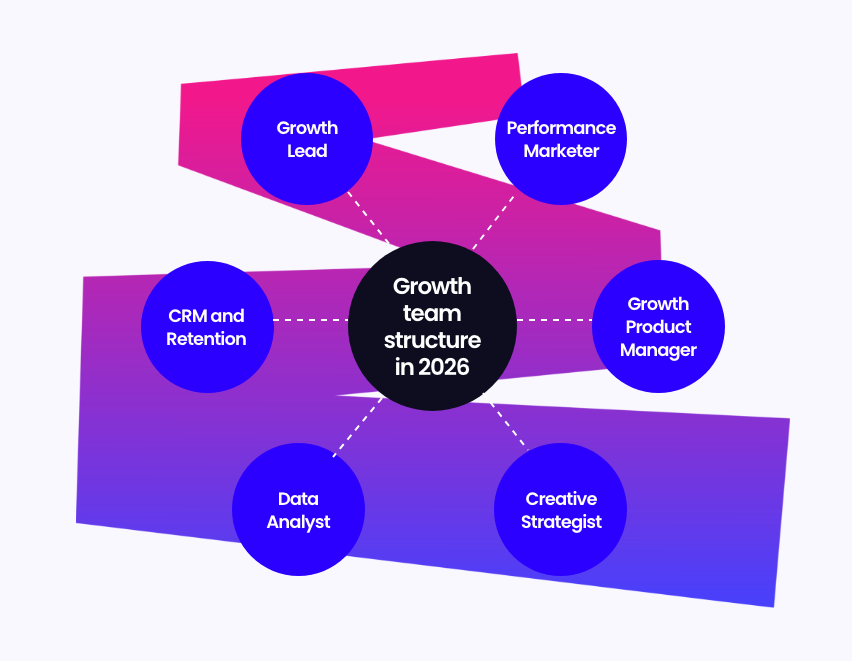
The core structure of how elite growth teams will be organised in 2026

Whether you’re building an in-house team or partnering with an agency (spoiler: the best brands do both), understanding these roles is critical.

1. Growth lead or head of growth

What they do
The strategic architect. They set the growth roadmap, prioritise experiments, and ensure every initiative ladders up to revenue and retention goals.

Key skills in 2026

  • Deep understanding of unit economics (CAC, LTV, payback periods)
  • Experience with AI and automation tools
  • Data fluency (comfortable in analytics dashboards and data warehouses)
  • Cross-functional leadership

Why it matters
This role has evolved from ‘run ads and hope for the best’ to ‘orchestrate omnichannel growth engines’. The best growth leads think like product managers: data-driven, metric-obsessed, and ruthlessly focused on ROI.

2. Performance marketing manager

What they do
Owns paid acquisition across Meta, Google, TikTok, and emerging channels. In 2026, this role is less about manual bid adjustments and more about creative strategy, audience insights, and algorithmic collaboration.

Key skills in 2026

  • AI-assisted campaign optimisation and predictive analytics
  • Creative testing frameworks (static, video, UGC)
  • First-party data activation
  • Multi-touch attribution modelling

The shift
With AI handling 60%+ of tactical optimisation, performance marketers are now strategists and data interpreters. They understand why campaigns work, not just which buttons to push. It’s precisely why we’ve helped The Gut Stuff increase purchases by 40% while decreasing costs by 30%.

3. CRM and retention specialist

What they do
Owns email, SMS, push notifications, and loyalty programmes. They turn one-time buyers into repeat customers and evangelists.

Key skills in 2026

  • Advanced segmentation and predictive modelling
  • AI-powered personalisation (dynamic content, send-time optimisation)
  • Lifecycle marketing and win-back campaigns
  • Cohort analysis and churn prediction

Why retention rules in 2026
With iOS privacy changes and rising CAC, the brands winning today are those obsessed with LTV. A 10% improvement in retention can double your growth trajectory, without spending a penny more on ads. This is where amateur agencies fall short. They chase new customers while ignoring the goldmine of existing ones.

4. Growth product manager

What they do
Bridges marketing and product. Owns the on-site experience, conversion rate optimisation, and growth features (referrals, subscriptions, bundles).

Key skills in 2026

  • A/B testing and experimentation frameworks
  • UX research and behavioural psychology
  • Collaboration with dev teams on growth features
  • Analytics (GA4, heatmaps, session recordings)

The unlock
Successful brands realise that growth isn’t just about driving traffic; it’s about converting and retaining it. Driving 100,000 visitors to a site that converts at 1% is far worse than driving 50,000 to a site that converts at 3%. This role ensures every pound spent on acquisition has maximum impact.

5. Data analyst or growth analyst

What they do
The truth-teller. They build dashboards, model attribution, and uncover insights that inform every decision the growth team makes.

Key skills in 2026

  • SQL and data visualisation tools (Looker, Tableau, Mode)
  • Statistical analysis and experimentation design
  • Customer data platform (CDP) management
  • Predictive analytics and machine learning basics

Why is this role important
In 2026, data isn’t just nice to have; it’s your competitive moat. Brands that can measure incrementality, attribute revenue accurately, and predict customer behaviour are light-years ahead of those flying blind. If your current agency can’t explain exactly which channels and campaigns are driving profitable revenue, you’re working with the wrong partner.

6. Creative strategist

What they do
Drives the creative engine. Produces scroll-stopping ads, landing pages, and content that resonates emotionally while converting commercially.

Key skills in 2026

  • AI-assisted creative production (generative tools, rapid prototyping)
  • Platform-native storytelling (TikTok, Reels, YouTube Shorts)
  • UGC sourcing and creator partnerships
  • Creative analytics (understanding which ad, formats, and messages perform)

The evolution
Creative is no longer a subjective art; it’s a testable science. The best creative strategists in 2026 operate like growth hackers, running 50+ creative tests per month and doubling down on winners.

7. Growth engineer 

What they do
Builds the tech stack and automates workflows. They’re the glue between marketing tools, data pipelines, and growth initiatives.

Key skills in 2026

  • API integrations and no-code or low-code tools (Zapier, Make, Retool)
  • Tag management and event tracking (GTM, Segment)
  • Basic front-end development (HTML, CSS, JavaScript for landing pages)
  • AI tool implementation and prompt engineering

Why do you need this role
The modern growth stack has 15-30 tools. Without a growth engineer, your team drowns in manual processes, broken integrations, and incomplete data. This role unlocks speed and scale.

The ideal team size for different growth stages

Startup (£0–1M revenue)

Recommended structure
Partner with a specialist performance agency to access full-stack growth expertise without the overhead of multiple senior hires.

Core needs

  • Strategic partner managing paid acquisition and retention
  • Fractional growth lead, often agency-side
  • Internal brand or content owner
  • Freelance creative support

Why this works
Early-stage brands need speed, learning velocity, and senior thinking without committing to a heavy payroll. This model provides breadth, experience, and execution while preserving cash flow.

Scale-up (£1M–10M revenue)

Recommended structure
Hybrid model with internal strategic leadership supported by specialist agency execution.

Core team

  • Head of growth
  • Performance marketing manager
  • CRM and retention manager
  • Agency partner for execution
  • Data analyst
  • Creative strategist
  • Growth engineer

Why this works
This stage demands tighter ownership and deeper brand context, while still benefiting from specialist depth and execution capacity. Agencies function best here as embedded partners, not external vendors.

Established (£10M+ revenue)

Recommended structure
Primarily in-house growth team, supported by agencies for specialist channels, innovation, and overflow.

Core team

  • VP of growth
  • Performance marketing team (3–5 in-house)
  • Retention marketing team (2–3 in-house)
  • Growth product team (2–3 in-house)
  • Data and analytics team (2+ analysts)
  • Creative team (2–3 in-house strategists plus external creators)
  • Marketing technology manager
  • Agency partners for specialist and experimental initiatives

Why this works
At scale, internal capability is essential. Agencies remain valuable for external perspective, pattern recognition across accounts, and rapid execution during peak demand or channel expansion.

The workflows that separate elite teams from the rest

We have refined these workflows across hundreds of client engagements. Here’s what actually works.

Weekly growth plan

Monday
Sprint planning. Review OKRs, prioritise experiments, and align on the week’s focus. For our clients, this is when we present the week’s strategy and get alignment.

Wednesday
Mid-week check-in. Assess live campaigns, address blockers, and adjust tactics. We flag opportunities and risks, no waiting until Friday to discover a budget burned on underperforming creative.

Friday
Learning review. Analyse completed ad performance, document insights, and plan next tests. This is where we turn data into institutional knowledge.

Testing cadence
Elite teams run 8-15 ad tests per month across channels. We follow a rigorous process

Idea formation (based on data, not gut feel)
Experiment design (clear success metrics and test parameters)
Execution (speed matters, launch fast, iterate faster)
Analysis (statistical significance plus qualitative insights)
Documentation (build an institutional knowledge base)

Cross-functional collaboration
Growth doesn’t happen in a silo. Elite teams have

  • Weekly syncs between agency and internal stakeholders (we align on brand, product launches, and strategic priorities)
  • Bi-weekly creative reviews (our performance marketers and creative strategists dissect what’s working and why)
  • Monthly business reviews (presenting growth metrics, forecasts, and strategic recommendations to leadership)

The data infrastructure powering successful brands

Data infrastructure isn’t considered important until it’s the reason your competitor is scaling profitably while you’re burning cash on guesswork. We insist that clients have proper foundations. Here’s the modern growth stack we implement.

  1. Customer data platform (CDP)
    Examples

    Segment, mParticle, RudderStack
    Why it’s essential
    Unifies customer data from your website, app, email, ads, and warehouse into a single source of truth. Enables real-time personalisation and accurate attribution.
    Our approach
    For most B2C brands, we implement Segment or Klaviyo’s CDP capabilities, depending on scale and budget.
  2. Data warehouse
    Examples

    Snowflake, BigQuery, Redshift
    Why it’s essential
    Centralised storage for all your marketing, product, and revenue data. Powers advanced analytics, custom dashboards, and predictive models.
    Our approach
    We help clients set up BigQuery (cost-effective for most) and build the pipelines that feed it. This is where we unlock attribution modelling that actually works.
  3. Business intelligence (BI) tools
    Examples

    Looker, Tableau, Metabase, Google Data Studio
    Why it’s essential
    Visualises data so teams can monitor performance, spot trends, and make decisions fast. No more waiting days for an analyst to pull a report.
    Our approach
    We build custom dashboards showing real-time ROAS, CAC, LTV, and contribution margin by channel. Our clients always know exactly where they stand.
  4. Attribution and analytics platform
    Examples

    Google Analytics 4, Triple Whale, Northbeam, Rockerbox
    Why it’s essential
    Tells you which channels, campaigns, and creatives are actually driving revenue. In 2026, multi-touch attribution and incrementality testing are non-negotiable.
    Our approach
    Proper GA4 implementation (most brands get this wrong), enhanced with a platform like Triple Whale for DTC-specific insights. We also run holdout tests and geo-experiments for true incrementality measurement.
  5. AI and automation layer
    Examples

    ChatGPT API, Claude, Make.com, Zapier, Supermetrics
    Why it’s essential
    Automates repetitive tasks (data pulls, reporting, creative variations) and augments decision-making with predictive insights.
    Our approach
    We use AI to automate reporting, generate creative variations, analyse sentiment, and predict customer behaviour. This efficiency is how we deliver enterprise results without enterprise retainers.
  6. Experimentation and personalisation platform
    Examples

    Optimizely, VWO, Dynamic Yield, Convert
    Why it’s essential
    Enables A/B testing, multivariate testing, and personalised experiences at scale. Turns your website into a constantly improving revenue machine.
    Our approach
    Integrated CRO is part of our web design service. We build sites on Shopify and custom platforms with testing built in from day one. That 63% average conversion rate uplift? It comes from relentless experimentation.
  7. CRM and lifecycle marketing platform
    Examples

    Klaviyo (DTC), HubSpot (B2B), Iterable, Braze
    Why it’s essential
    Powers email, SMS, and push campaigns with advanced segmentation, automation, and AI-driven personalisation.
    Our approach
    As Klaviyo partners, we architect retention strategies that turn one-time buyers into brand evangelists. We’ve helped brands increase email-attributed revenue by 40-80% through proper segmentation and flow optimisation.

The AI revolution: how automation is reshaping growth teams

AI isn’t a buzzword anymore; it’s a competitive advantage. Here’s how we’re leveraging AI to deliver better results, faster.

  • Creative production
    AI-generated ad variations (text, images, video concepts)
    Automated A/B testing of hooks and calls to action
    Predictive analysis of which creative concepts will perform before spending a penny
  • Campaign optimisation
    Algorithmic bid management with strategic human oversight
    Predictive audience expansion based on LTV models
    Real-time budget reallocation across channels and campaigns
  • Customer insights
    Churn prediction models identify at-risk customers
    LTV forecasting informs acquisition strategies
    Sentiment analysis from reviews, support tickets, and social media
  • Operational efficiency
    Automated reporting and dashboard creation (saving 20+ hours weekly)
    AI assistants summarising campaign performance and recommending actions
    Predictive alerting when campaigns underperform or opportunities emerge
  • The human edge
    While AI handles tactical execution and data crunching, elite agencies provide the strategic thinking, creative intuition, and high-stakes decision-making AI can’t replicate. AI is used to be faster and smarter, not to replace expertise.

The future of growth teams! What’s coming next

Looking beyond 2026, here’s what we are preparing clients for.

Hyper-personalisation at scale
AI-driven one-to-one experiences across email, site, and ads. Every customer sees a unique journey optimised for their behaviour and preferences.

Predictive growth models
Machine learning forecasts revenue, churn, and LTV with 90%+ accuracy. Growth teams will shift from reactive to proactive, stopping churn before it happens.

Voice and conversational commerce
Growth teams optimising for voice search, AI shopping assistants, and conversational interfaces. We are already testing this for forward-thinking clients.

Privacy-first growth
With third-party cookies gone and regulations tightening, first-party data strategies and privacy-preserving attribution will dominate. Brands that haven’t invested here will be blind.


Inside our 7-day performance creative ad sprint

Creative fatigue has become one of the biggest constraints in paid media performance. Not bidding. Not targeting. Creative!

As platforms optimise faster and audiences scroll harder, ads wear out quicker than they did even a year ago. Brands that continue to see efficiency gains are not trying to outsmart algorithms. They are building systems that consistently outproduce fatigue.

This is why we’ve created an efficient 7-day performance creative sprint to optimise creative production.

It is a structured framework designed to help our creative team ideate, produce, test, and deploy performance creative at scale, without relying on guesswork or bloated production cycles.

What our ad sprint looks like, and why it matters in 2026

Our performance creative sprint is a time-boxed process for generating and testing new ad creative quickly, with performance data guiding every decision.

Unlike traditional creative workflows that take weeks or months, a weekly sprint prioritises velocity and learning. The objective is not to produce one perfect asset, but to create a repeatable engine that feeds fresh, insight-led creative into live campaigns.

As we move into 2026, creative velocity has become one of the strongest predictors of paid social performance. Platforms optimise faster, audiences fatigue sooner, and the cost of standing still continues to rise.

The creative fatigue problem that most teams are underestimating

Creative fatigue happens when audiences are repeatedly exposed to the same ad concept. Engagement drops, costs rise, and conversion rates follow.

What has changed is how quickly this now happens.

AI-driven optimisation means platforms push winning ads harder and faster. Strong creatives hit saturation sooner, particularly in scaled accounts.

Common signals include

  • CTR erosion week over week
  • Rising CPA after an initial period of stability
  • Frequency climbing beyond sustainable levels
  • Hooks losing impact 

Many teams still treat this as a media problem. In reality, it is a creative operations problem.

Why traditional creative workflows are breaking down

Most creative processes were not designed for the way paid media now behaves. Especially after the Andromeda meta update. 

Typical failure points include

  • Long production timelines that cannot keep up with fatigue
  • Over-investment in polished assets over data-informed choices
  • Inconsistent testing frameworks
  • Performance insights sitting with media teams and never feeding back into creative 

The brands that will outperform in 2026 will not just be creating more ads in isolation. They will be producing more data-informed, insight-led, idea-rich creatives, faster.

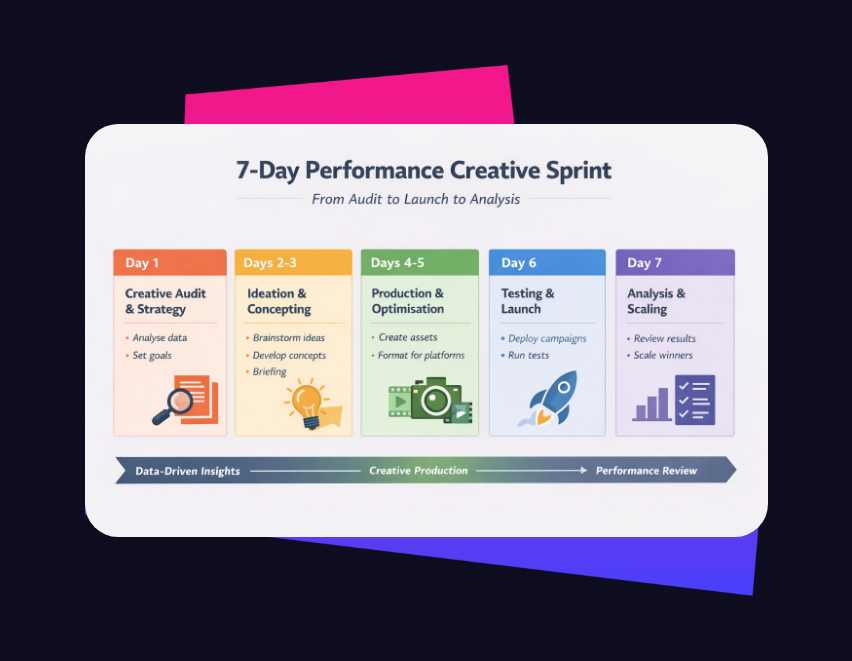
Our 7-day ad sprint planning

Our sprint is designed to be repeatable and scalable. Each day has a clear purpose and output, with performance data shaping decisions throughout.

Day 1. Creative audit and strategic foundation

We start with data and ideas, not just ideas.

The focus is on analysing creative metrics to evaluate performance baselines, identifying fatigue patterns, and understanding where creative gaps exist across the customer journey.

This includes

  • Reviewing recent creative performance
  • Identifying declining assets and recurring patterns
  • Mapping where messaging breaks down
  • Analysing competitor ads

The output is a creative ad plan grounded in performance insight, not opinion.

Days 2 to 3. Rapid ideation (ad plan) and briefing 

Our ad plan is structured and data-led.

We work across a defined set of creative angles, generating multiple ad concepts within each rather than spreading effort thinly.

These typically include (varies based on creative strategy)

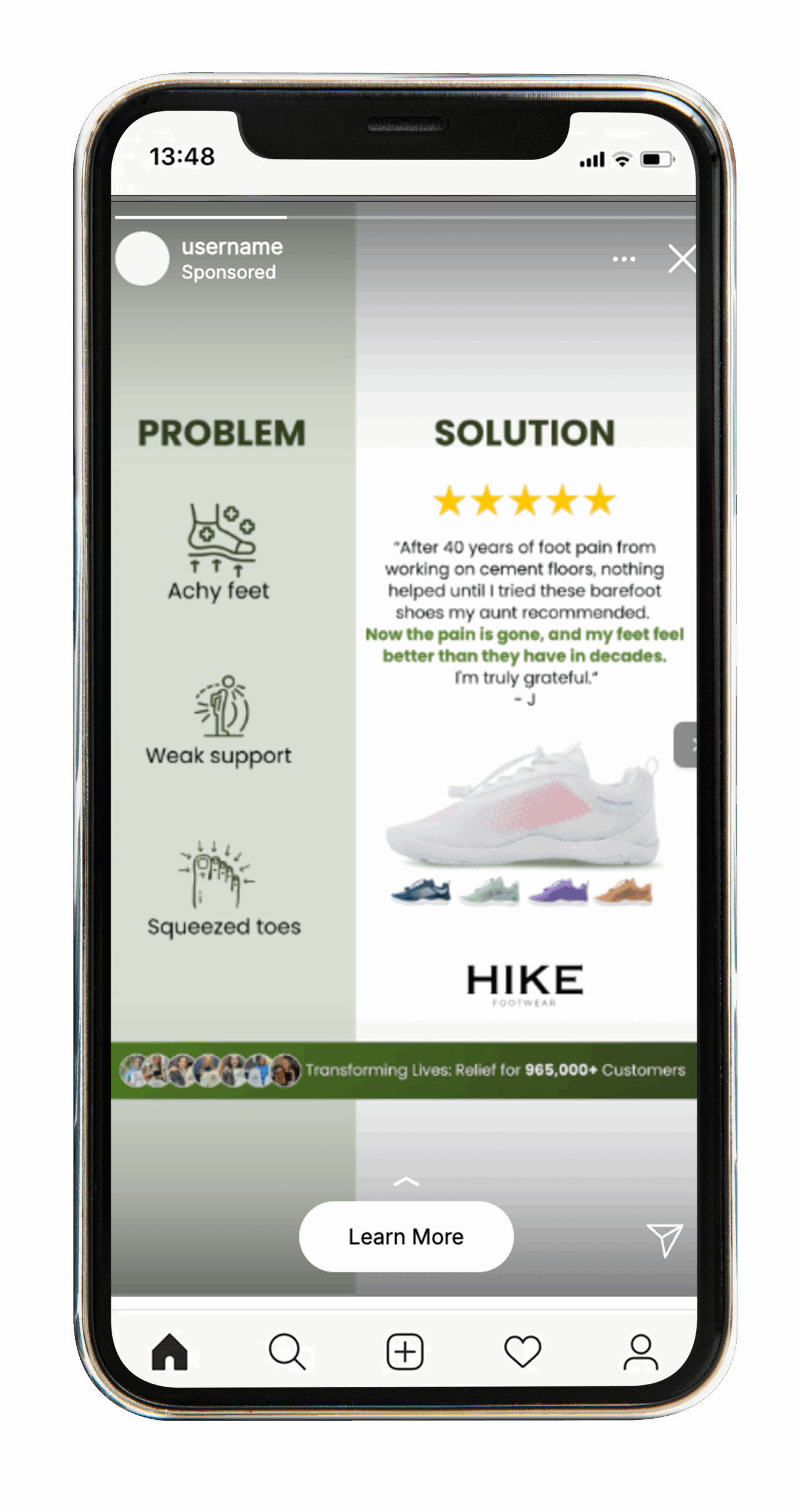
  • Problem and solution framing
  • Social proof and real-world validation
  • Expert authority
  • Contrarian messaging
  • Outcome-led transformation stories
  • Creative briefing for the production teams

Each concept is mapped to a specific context and goal.

As AI-generated content becomes more common, authentic UGC-style creative continues to outperform overly polished brand assets when the underlying insights are strong.

Days 4 to 5. Asset production

Production briefs go out a week ahead, and we typically give the production team a week to film and edit content. 

The aim is to ship just enough creatives by next week to learn, not to overbuild before testing.

Key principles include

  • Brief-specific execution
  • Efficient feedback loops
  • Platform-native formats
  • Built-in messaging frameworks 

Multiple formats are produced per concept, so performance signals can compound quickly.

AI supports the production stage by accelerating scripting, visualisation, and (for the next week) iteration, while strategic decisions remain human-led.

Day 6. Structured testing and launch

Creative is launched with control and clarity.

Key variables are isolated so performance drivers can be identified, not guessed.

Budgets are monitored, audiences are consistent, and learning windows are respected.

Early indicators such as hook rate and engagement quality are monitored alongside conversion signals.

Day 7. Analyse, iterate, and scale

The sprint does not end at launch.

Winning assets are identified, performance patterns are documented, and next-stage iterations are defined.

The budget is reallocated based on data and learnings, typically prioritising proven assets while reserving space for iteration and experimentation.

This is where the system compounds over time.

How AI is reshaping creative production

AI has changed the economics of creative production.

It now plays a role in

  • Quicker scripting and editing
  • Faster iterations of winning concepts 
  • Earlier detection of fatigue patterns

What it does not replace is strategic judgement.

The brands seeing sustained performance gains are using AI to remove friction from execution so teams can focus on insight quality, messaging clarity, and differentiation.

Performance creative in an answer-engine world

As answer engines increasingly influence discovery, creative has to work harder earlier in the funnel.

Audiences arrive more informed and more sceptical.

This has shifted performance creative toward

  • Education before persuasion
  • Authority before urgency
  • Explanation before conversion

Longer-form, insight-led creative now plays a meaningful role in warming the audiences before short-form conversion assets do their job.

Why this sprint plan works for us

This sprint plan works because it aligns creative, media, and insight into a single workflow that is designed and optimised to perform over time.

Our sprint plan ensures data-informed, insight-led, idea-rich performance creative is delivered consistently every other week. 

Creative fatigue is not something you solve once. It is something you must manage continuously. That is what our sprint plan is designed to do.


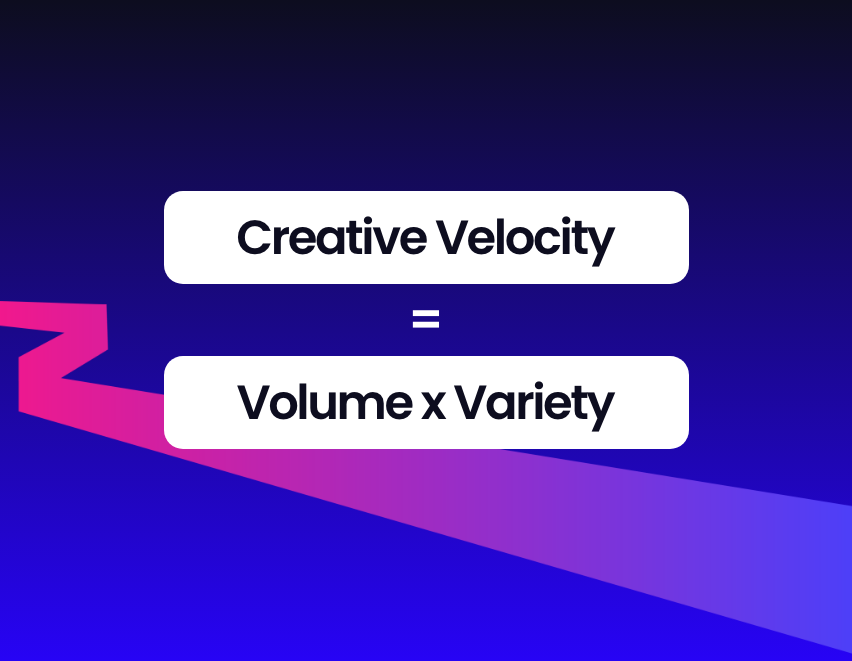
Creative velocity: the new growth lever and how to scale Meta with surging CPMs

The landscape has shifted. If you’re a performance marketer managing Meta ads in 2025, you’ve likely noticed something unsettling: your CPMs aren’t just creeping up; they’re surging. For many advertisers, costs per thousand impressions have climbed 30-40% year-over-year, compressing margins and forcing a fundamental reckoning with how we scale paid social.

The conventional playbook—audience segmentation, lookalike expansion, and budget laddering—still matters but is no longer sufficient. In an environment where auction competition intensifies quarterly, and Meta’s Andromeda AI shifts power away from granular targeting toward recommendation-based delivery, creative velocity has emerged as a definitive growth lever.

This isn’t about producing more ads. It’s about systematising creative iteration at a pace that outmanoeuvres rising costs and algorithm fatigue. Here’s how industry-leading performance marketers are adapting.

Why are CPMs rising?

Before diving into solutions, we need to understand the structural forces driving CPM inflation

  1. Increased platform competition

Meta’s advertising revenue continues to grow, reaching $39.9 billion in Q3 2024 alone, driven by more advertisers competing for the same inventory. Every brand pivoting to performance marketing adds pressure to the auction.

  1. Algorithmic consolidation

Meta’s shift toward Advantage+ Shopping Campaigns and the Andromeda update has reduced advertiser control over placement and targeting. The algorithm optimises across broader audiences, meaning you’re increasingly competing in the same auction pools as your competitors.

  1. Seasonal and macroeconomic factors

Q4 consistently sees CPM spikes of 20-50% due to holiday advertising demand. Add inflation, reduced consumer spending, and tighter budgets, and you’ve got a perfect storm for sustained cost increases.

  1. Creative saturation and ad fatigue

Meta’s algorithm rewards fresh, engaging creative. When ads grow stale, CTR declines, and CPMs rise disproportionately—your ads cost more to serve because they’re underperforming.

The data is clear: rising CPMs aren’t a temporary blip. They’re the new baseline. The question isn’t whether costs will rise—it’s whether your creative infrastructure can keep pace.

The strategic pivot: why creative velocity matters now

Traditional scaling strategies focused on audience expansion and budget allocation. Creative was treated as a variable you optimised around, not through. That paradigm is now obsolete. In 2025, creative velocity—the rate at which you produce, test, and iterate new ad concepts—is the single most reliable way to offset rising CPMs. Here’s why…

Fresh creative resets frequency and engagement

As ad frequency climbs, performance degrades. New creative resets the engagement curve, keeping CTR high and CPMs suppressed. Brands shipping 10-15 new creative variants per week consistently see 15-25% lower CPMs than those running static creative for weeks on end.

Increased testing volume expands your winner pool

More creative in-market means more chances to discover breakout ads. In a high-CPM environment, a single winning creative can carry an account. Brands testing 30+ concepts monthly have a statistically higher probability of finding those outliers.

Creative variety fuels algorithmic learning

Meta’s algorithm thrives on diversity. Feeding it multiple creative angles—different hooks, formats, and messaging—accelerates the learning phase and unlocks incremental reach. Accounts with high creative diversity scale more predictably.

Speed compounds competitive advantage

Your competitors are slow. Most brands take 2-4 weeks to produce new creative. If you can compress that to 3-5 days, you gain a structural edge, capturing market share while others are still briefing designers.

The creative velocity framework: how to operationalise speed without sacrificing quality

Here’s the tactical blueprint for building a creative engine that scales profitably, even as CPMs climb.

  1. Establish a creative testing cadence

Performance marketing isn’t a creative discipline; it’s a scientific one. Treat your ad account like a laboratory.

Weekly shipment target: Launch 8-12 new creative concepts per week across your active campaigns. This isn’t arbitrary; it’s the minimum threshold to maintain statistical confidence and avoid creative fatigue.

Creative segmentation: Test across three core variables: hooks, formats and messaging.

  1. Implement modular creative production

Speed requires efficiency. The fastest-growing brands aren’t hiring massive creative teams; they’re building modular creative workflows.

Template-based production: Develop 5-10 high-performing templates (video editing sequences, graphic layouts, animation styles) that can be rapidly customised. This cuts production time by 60-70%.

User-generated content (UGC) at scale: Partner with content creators or micro-influencers who can ship raw, authentic footage weekly. UGC creative consistently outperforms polished brand assets—and it’s faster and cheaper to produce.

AI-assisted iteration: Tools like ChatGPT, Midjourney, and Runway ML can accelerate scripting, storyboarding, and asset generation. Use AI to expand your creative bandwidth, not replace strategic thinking.

  1. Adopt rapid testing protocols

Meta’s algorithm delivers results fast. You don’t need weeks to know if your creative works.

48-72 hour kill threshold: If a new ad hasn’t delivered meaningful engagement or conversions within 2-3 days, kill it. Don’t let underperformers drag down account performance.

Dynamic budget allocation: Use Campaign Budget Optimisation (CBO) to let Meta shift spend toward winning creative automatically. Pair this with manual management—CBO isn’t perfect, but it’s faster.

Incremental scaling: When you find a winner, scale conservatively—increase budgets by 20-30% every 2-3 days rather than doubling overnight. This preserves algorithmic stability.

  1. Monitor creative fatigue metrics

You can’t manage what you don’t measure. Track these KPIs weekly:

Frequency: Keep it below 2.5-3.0 for cold audiences and 4.0-5.0 for retargeting. Higher frequency signals saturation.

CTR decay: If CTR drops 30%+ week-over-week, creative may be fatiguing. Refresh immediately.

CPM trend: If CPMs rise 15%+ without corresponding audience expansion, you’re paying the “boredom tax.” New creative will fix it.

  1. Build a creative intelligence system

The best advertisers don’t test randomly; they learn systematically.

Creative performance database: Document every creative concept, including format, hook, messaging angle, and performance data (CTR, CPA, ROAS). This creates an institutional knowledge base that informs future creative.

Competitive creative audits: Monitor competitor creative monthly. Identify patterns in what’s working and adapt strategically.

Qualitative feedback loops: Don’t just trust the algorithm. Survey customers, run focus groups, and analyse comments on organic posts. Qualitative insights often reveal creative angles that the data can’t.

Common pitfalls (and how to avoid them)

Mistake #1: Prioritising quantity over quality

Speed and volume are useless without strategic direction. Every creative should have a reason for being tested that is tied to your customer insights.

Mistake #2: Only relying on AI creative tools

AI can accelerate production, but it can’t replace brand understanding or strategic intuition. Use AI to scale execution, not strategy.

Mistake #3: Testing too many variables simultaneously

Test one primary variable at a time (hook, format, or messaging). Testing everything at once muddies attribution and slows learning.

The path forward: Building sustainable growth in a high-CPM world

Rising CPMs aren’t a problem to solve; they’re a market reality to adapt to. The brands that thrive won’t be those with the biggest budgets. They’ll be those with the fastest and most efficient creative engines.

Here’s a tactical roadmap

  • Audit your current creative velocity. How many new concepts are you shipping weekly? If it’s fewer than 8, you’re behind.
  • Invest in creative infrastructure. Build templates, recruit UGC partners, and train your team on rapid iteration loops.
  • Adopt a test-and-learn culture. Treat every campaign as a creative experiment. Document learnings. Kill losers fast. Scale winners aggressively.
  • Monitor the right metrics. Frequency, CTR decay, and CPM trends are your early warning system for creative fatigue.
  • Stay nimble. Meta’s algorithm evolves constantly. What works today won’t work in three months. The only constant is change—and your ability to adapt faster than your competition.

The performance marketing landscape has fundamentally shifted. Creative is no longer a cost centre; it’s your primary growth lever. And in a world where CPMs rise 40% year-over-year, creative velocity isn’t just an advantage. It’s survival.


AI UGC at a fraction of traditional content costs – 5 AI tools we love

What AI UGC is and why it matters

User-generated content has long been the gold standard for authentic brand storytelling. But here’s the problem: traditional UGC campaigns are expensive, slow, and unpredictable. Between sourcing creators, managing contracts, multiple revision rounds, and final delivery, brands often spend £500–£2,000 per piece of content.

AI UGC changes that equation.

AI-powered user-generated content uses artificial intelligence to produce authentic-looking, UGC-style videos that replicate real customer testimonials at a fraction of the cost. Research shows AI-generated UGC can reduce content creation expenses by up to 90 per cent while maintaining the authenticity that drives conversions.

We’ve integrated AI UGC into our performance marketing strategies for clients across sectors, from fast-growth start-ups to established scale-ups. The result: more content, faster testing, and measurable gains in ROI.

How traditional UGC is breaking your budget

Before exploring the tools, it’s worth addressing the core issue: traditional UGC is increasingly becoming unsustainable for most brands.

The true cost of traditional UGC

  • Creator fees: £300–£1,500 per video
  • Platform fees: 15–30% commission to UGC marketplaces
  • Revision cycles incur additional costs and delays 
  • Usage rights are often limited to three–six months
  • Hit or miss quality, with no guarantee that the content will perform

For a typical campaign requiring 10–20 pieces of content for ad testing, costs can easily reach £5,000–£30,000 before knowing what actually works.

The AI UGC alternative

  • Per video cost £10–£50
  • Production time minutes or hours, not weeks
  • Unlimited variations to test multiple angles instantly
  • Full usage rights with no expiry
  • Consistent quality as AI models improve with every iteration

Our performance data confirms AI-generated content consistently achieves comparable, and at times better, CTRs than traditional UGC when executed correctly.

5 AI tools we use for AI UGC creation

After testing dozens of AI platforms, these five have earned a permanent place in our production workflow, each serving a unique role within our AI UGC pipeline.

Arcads.ai for AI avatar video creation

Best for UGC-style video testimonials using AI avatars

Arcads is our go-to for rapid AI UGC video production. It generates scripted testimonials delivered by lifelike avatars with convincing gestures and expressions.

How we use it

  • Create multiple video variations for A/B testing
  • Generate testimonials in varied accents and demographics
  • Produce unboxing-style videos for e-commerce clients
  • Scale video output across markets without reshoots

Key features

  • More than 100 diverse AI avatars across age, ethnicity, and style
  • Script to video in under five minutes
  • Natural gestures, expressions, and lip sync
  • Customisable backgrounds and environments

Results: For one D2C client, we produced 15 AI UGC videos in a day, replacing a £12,000 creator campaign. Three outperformed the originals, cutting cost per acquisition by 34%.

Pricing: From $99 per month for 20 video credits

Pro tip: Write scripts conversationally, not like ad copy. Natural phrasing boosts believability.

Synthesia.io for professional AI spokesperson videos

Best for explainer videos, product demos, and branded messages

Synthesia is ideal for polished, professional content that still feels personal.

How we use it

  • Produce founder-style videos without on-set filming
  • Create multi-language product demos for global audiences
  • Generate personalised customer videos at scale
  • Build training and educational content for email sequences

Key features

  • More than 160 ultra-realistic avatars
  • More than 120 languages and accents
  • Custom avatar creation from photos
  • Screen record integration for demos
  • Brand templates for visual consistency

Results: A SaaS client required explainer videos in eight languages. Traditional production quoted £45,000 and 12 weeks. Using Synthesia, we delivered all versions in three days for under £500, achieving a 6.5x ROAS.

Pricing: From $29 per month (Starter)

Pro tip: Use the custom avatar option to create digital twins of your team for authentic brand representation.

Opus Clip for AI video repurposing

Best for turning long-form video into viral short-form content

Opus Clip isn’t strictly an AI UGC platform but has revolutionised how we extend the lifespan of existing video assets.

How we use it

  • Convert webinars into bite-sized social clips
  • Extract key moments from customer testimonials
  • Repurpose podcasts into vertical video ads
  • Create UGC-style reactions from interviews

Key features

  • Automatically identifies the most engaging segments
  • Auto captions with high accuracy
  • Auto resizes for TikTok, Instagram, and YouTube Shorts
  • Adds B-roll, transitions, and predicted virality scores

Results: From a single 45-minute customer interview, we generated 27 clips. Four reached over 100k organic views and two became top-performing paid ads that quarter.

Pricing: free tier available, pro plans from $29 per month

Pro tip: Upload genuine customer videos. Opus will extract emotionally resonant soundbites that double as social proof.

Midjourney for AI image generation and visual UGC

Best for lifestyle imagery, product mock-ups, and creative concepts

Midjourney has matured into a commercial-grade tool for creating photorealistic UGC style imagery that rivals professional photography.

How we use it

  • Generate lifestyle imagery for ad testing
  • Produce seasonal visuals without photoshoots
  • Create user in the environment scenes for social ads
  • Build campaign mood boards pre-production

Key features

  • Photorealistic rendering and style control
  • Consistent character recreation
  • Brand-consistent style referencing
  • High-resolution output suitable for print

Results: For a fashion client, Midjourney generated 40 lifestyle images comparable to a £15,000 photoshoot, at a total cost of £120.

Pricing: $10–$120 per month, depending on usage

Pro tip: Upload a real customer image as a style reference to preserve authenticity while expanding creative flexibility.

ElevenLabs for AI voice and audio generation

Best for voiceovers, audio testimonials, and podcasts

High-performing UGC isn’t limited to visuals. ElevenLabs enables authentic audio storytelling at scale.

How we use it

  • Generate voiceovers in multiple languages
  • Transform text reviews into spoken testimonials
  • Produce podcast-style content without studio time
  • Add narration to silent video UGC

Key features

  • Voice cloning from one-minute audio samples
  • 29 languages with realistic accents
  • Emotional tone control
  • Long-form audio generation for podcasts

Results: For a wellness client, we converted more than 50 text reviews into audio testimonials for a radio campaign. The project cost £45 and was completed in a single afternoon.

Pricing: free tier, paid plans from $5 per month

Pro tip: Clone your founder’s or spokesperson’s voice once, then reuse it indefinitely to maintain brand consistency.

How to integrate AI UGC into your content strategy

  • Start with testing, not replacement
    Run AI-generated and human UGC side by side to establish benchmarks.
  • Optimise for authenticity
    Include natural imperfections such as pauses, casual phrasing, and real-world backdrops.
  • Leverage speed for iteration
    AI UGC’s edge is velocity. Test more variations to uncover winners faster.
  • Combine AI and human creativity
    Use AI for scale, but keep strategy human-led. The best results blend technology and intuition.
  • Disclose when appropriate
    Transparency matters, especially in regulated industries.

Estimating the cost impact of AI UGC

Across campaigns, AI UGC typically delivers cost savings of between 85 and 95% compared with traditional creator production, with turnaround times reduced by as much as 70 to 90%. Exact savings vary by campaign scope, usage rights, and production volume, but the difference in both cost and speed is significant enough to transform creative testing velocity.

The future of AI UGC in 2026 and beyond

  • Real-time personalisation at the viewer level
  • Interactive AI avatars for dynamic engagement
  • Emotion-optimised creative driven by performance data
  • Synthetic brand communities that scale advocacy

Brands that adopt AI UGC now will gain a lasting competitive advantage as these innovations mature in 2026.


Why performance creative outperforms brand creative on paid social

Paid social is one of the most powerful growth channels for e-commerce brands, yet it’s also one of the most misunderstood. Many businesses still believe the same brand creatives they use for packaging, websites, and traditional advertising should perform just as well on Meta or TikTok. In reality, polished, on-brand content is often scrolled past without a second thought when used as ad content.

The ads that cut through the noise usually look very different. Some of the best-performing paid social creatives don’t look like branded content at all. They look raw, unpolished, and sometimes “off-brand”. 

After running thousands of tests across industries and niches, from fashion and beauty to wellness and consumer tech. The results we’ve seen are consistent: performance ads that speak to the right consumer, at the right time and with the right messaging, don’t just generate engagement; they drive measurable growth.

Performance creative vs brand creative: understanding the difference

Brand creative is designed to showcase a consistent brand identity. It’s polished, controlled, and strictly aligned to guidelines. Think product photography, billboard campaigns, or sleek website visuals.

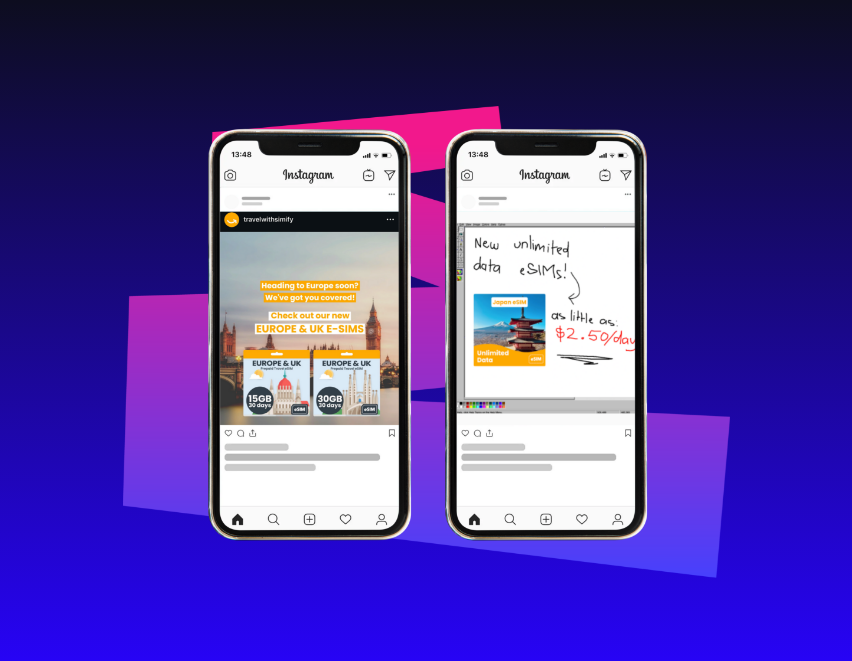
Performance creative, on the other hand, is not necessarily brand-aligned in design. It’s built to look native to the feed. Instead of standing out as an obvious ad, it’s meant to convey a message that is resonant and/or triggers a response. It’s scrappy, fast-moving, and guided by data rather than design perfection.

A simple analogy captures the difference: brand creative builds your reputation, performance creative drives your sales. One reinforces who you are; the other delivers measurable outcomes. Both matter, but they serve different purposes in your paid social creative strategy.

Why audiences prefer performance ads

Social platforms are not print magazines or TV spots. Social feeds are noisy, unpredictable environments where audiences skim, swipe, and scroll. Polished, studio-shot content often feels out of place and can trigger ad-blindness.

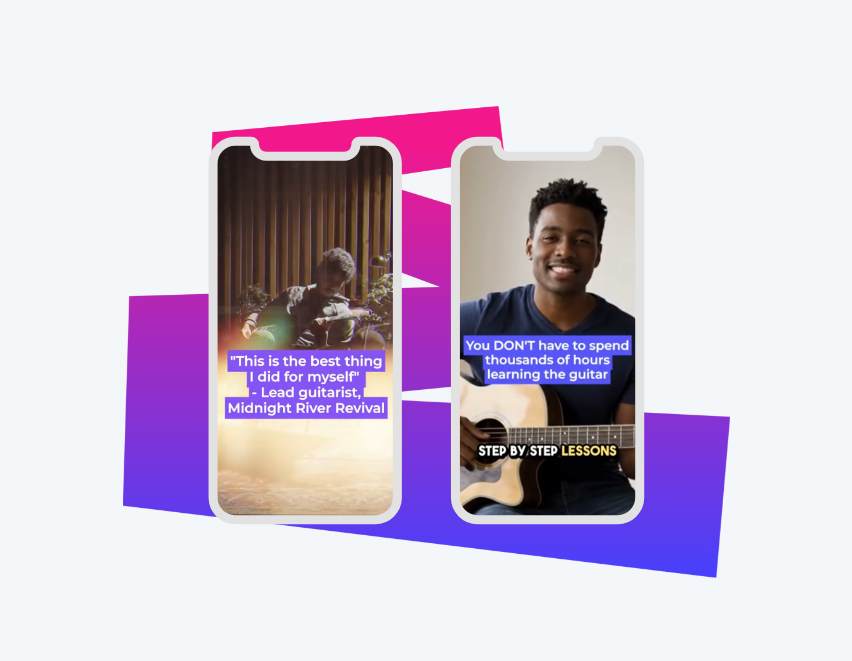
Performance creatives win because they feel authentic. A lo-fi selfie, user testimonial or a rough product demo looks like content your friend might post. That relatability builds trust quickly.

When customers say, “this feels like someone I’d follow, not a brand trying to sell to me,” you know the creative is working.

The four principles of performance creative

After thousands of experiments, creative tests and iterations, four core principles consistently underpin effective performance ads for e-commerce brands.

1. Intentional creative strategy

Unpolished doesn’t mean sloppy. When we run ads that look raw or “off-brand”, it’s never by accident. It’s deliberate. These creatives are designed to mimic platform-native behaviour and grab attention in crowded feeds.

The goal is simple: make your ad look less like an ad and more like content people want to watch, click, or share. This intentional approach is what makes a paid social creative strategy scalable.

2. Creative diversity as a growth lever

Paid social punishes repetition. Running the same style of creative leads to fatigue over time, wasted spend, and declining returns. The fix is creative diversity.

A strong creative ecosystem should include

  • UGC-style product demos
  • Testimonials from real customers
  • Carousel ads to showcase range
  • Educational explainer videos
  • Meme-style content
  • Polished brand assets for retargeting, amongst other creative formats.

Each creative format plays a different role in the funnel. Diversity ensures that you don’t just generate impressions; you build a full customer journey.

3. Data-driven validation

One of the most common concerns brands have is that certain creatives “don’t feel like our brand”. But feelings don’t pay the bills, data does.

Every piece of creative should be validated through creative testing for paid social campaigns. By measuring ROAS, CPA, click-through rates, and creative-level engagement, you will see which ads are working and which are not.

The lesson? Never dismiss an ad because it feels off-brand. Dismiss it if the data shows it doesn’t perform.

4. Customer-centred research

The best ads for e-commerce brands come directly from the customer’s voice. Mining reviews, social behaviour, and competitor activity uncovers insights you won’t find in a brand guidelines deck.

If data highlights frustration with complicated instructions, create an explainer video. If people rave about customer service, turn that into a testimonial ad. By aligning creatives with audience pain points and triggers, you build resonance that translates into sales.

Why brands resist performance creative

Despite the evidence, resistance is common. Brand teams often push back with: “This doesn’t look on brand.”

The truth is, audiences don’t judge ads by brand guidelines. They judge them by whether they’re engaging, relatable, and useful. What looks “off-brand” internally often looks authentic externally.

Even leading luxury brands like Gucci test into native-style creative. If global names can embrace lo-fi ads, smaller brands can — and must — do the same.

Case studies: performance ads for e-commerce brands

Fashion retailer

One fashion brand was reluctant to use UGC try-on videos. They preferred polished studio shoots. But once we tested both side by side, the results were undeniable. UGC delivered triple the click-through rate and reduced CPA by 40%.

Skincare brand

A beauty client dismissed lo-fi “before and after” clips as too rough. Within weeks of testing, those clips became their top-performing creatives, generating higher engagement and organic shares alongside paid growth.

Lifestyle DTC

A lifestyle wellness brand leaned too heavily on polished storytelling. Adding memes and humorous pain-point ads unlocked a steady stream of cost-efficient conversions and gave campaigns longer shelf life.

Each case shows why performance ads for e-commerce brands consistently outperform glossy brand assets.

How to build a creative ecosystem for ads

The smartest brands don’t choose between performance and brand creatives. They integrate them into a single ecosystem that scales.

  • Top of funnel: Relatable UGC, memes, and attention-grabbing lo-fi assets.
  • Middle of funnel: Testimonials, product explainers, and educational content.
  • Bottom of funnel: Offer-led and storytelling-driven ads to close the sale.

This balance ensures your paid social creative strategy delivers both engagement and conversions.

The role of creative testing in paid social campaigns

Creative testing is where strategy becomes measurable. By running structured tests, you can identify:

  • Which hooks capture attention fastest
  • Which formats drive the most conversions
  • How creative performance changes over time

For example, we often run multivariate tests on UGC hooks. A skincare ad might test three different hooks: “My night routine”, “I’ve struggled with dry skin for years”, or “This moisturiser is viral on TikTok”. Data shows within days which opener resonates most.

This process of creative testing for paid social campaigns allows brands to scale confidently, knowing they’re not betting on guesswork.

Setting expectations with performance creatives

Managing expectations is critical in client onboarding. We explain early that performance creatives may look different from brand assets, and that’s intentional. When framed as part of a tested, data-driven system, clients quickly understand the value.

As we tell all our clients: don’t view performance creative as replacing brand creative. View it as the lever that turns your brand assets into revenue-driving machines.

Performance creative isn’t about lowering design standards. It’s about raising results. By embracing intentional creative strategy, creative diversity, data-driven testing, and customer-centred insights, brands unlock scalable growth.

The difference between brand creative and performance creative comes down to purpose. Brand creatives build identity; performance creatives drive action. Together, they create a system that doesn’t just generate impressions but consistently fuels revenue.

If you’re serious about scaling, start with a data-powered and research-driven paid social creative strategy, invest in creative testing for paid social campaigns, and trust the data. The brands that do not just compete; they lead.