Creative velocity: the new growth lever and how to scale Meta with surging CPMs

The landscape has shifted. If you’re a performance marketer managing Meta ads in 2025, you’ve likely noticed something unsettling: your CPMs aren’t just creeping up; they’re surging. For many advertisers, costs per thousand impressions have climbed 30-40% year-over-year, compressing margins and forcing a fundamental reckoning with how we scale paid social.
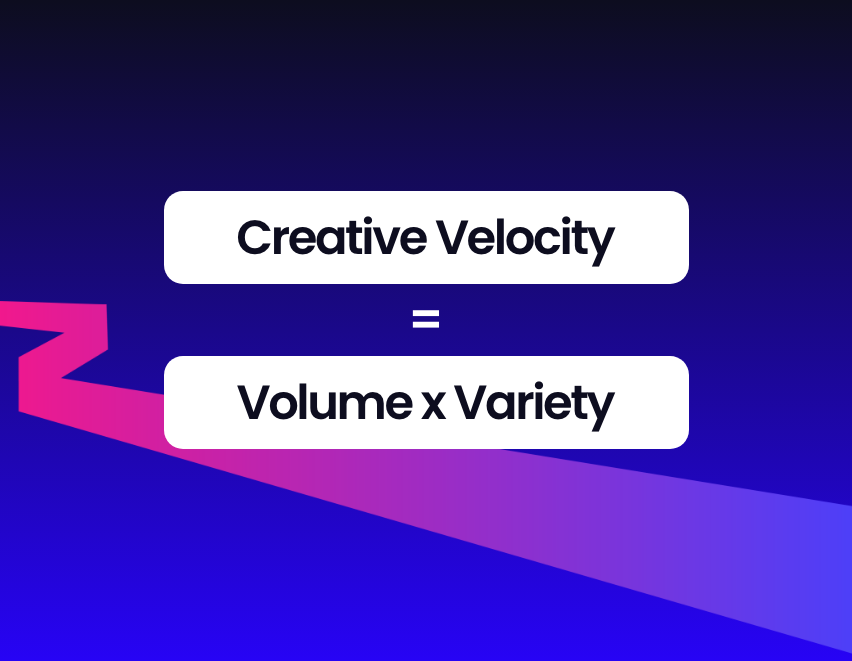
The conventional playbook—audience segmentation, lookalike expansion, and budget laddering—still matters but is no longer sufficient. In an environment where auction competition intensifies quarterly, and Meta’s Andromeda AI shifts power away from granular targeting toward recommendation-based delivery, creative velocity has emerged as a definitive growth lever.
This isn’t about producing more ads. It’s about systematising creative iteration at a pace that outmanoeuvres rising costs and algorithm fatigue. Here’s how industry-leading performance marketers are adapting.
Why are CPMs rising?
Before diving into solutions, we need to understand the structural forces driving CPM inflation
- Increased platform competition
Meta’s advertising revenue continues to grow, reaching $39.9 billion in Q3 2024 alone, driven by more advertisers competing for the same inventory. Every brand pivoting to performance marketing adds pressure to the auction.
- Algorithmic consolidation
Meta’s shift toward Advantage+ Shopping Campaigns and the Andromeda update has reduced advertiser control over placement and targeting. The algorithm optimises across broader audiences, meaning you’re increasingly competing in the same auction pools as your competitors.
- Seasonal and macroeconomic factors
Q4 consistently sees CPM spikes of 20-50% due to holiday advertising demand. Add inflation, reduced consumer spending, and tighter budgets, and you’ve got a perfect storm for sustained cost increases.
- Creative saturation and ad fatigue
Meta’s algorithm rewards fresh, engaging creative. When ads grow stale, CTR declines, and CPMs rise disproportionately—your ads cost more to serve because they’re underperforming.
The data is clear: rising CPMs aren’t a temporary blip. They’re the new baseline. The question isn’t whether costs will rise—it’s whether your creative infrastructure can keep pace.
The strategic pivot: why creative velocity matters now
Traditional scaling strategies focused on audience expansion and budget allocation. Creative was treated as a variable you optimised around, not through. That paradigm is now obsolete. In 2025, creative velocity—the rate at which you produce, test, and iterate new ad concepts—is the single most reliable way to offset rising CPMs. Here’s why…
Fresh creative resets frequency and engagement
As ad frequency climbs, performance degrades. New creative resets the engagement curve, keeping CTR high and CPMs suppressed. Brands shipping 10-15 new creative variants per week consistently see 15-25% lower CPMs than those running static creative for weeks on end.
Increased testing volume expands your winner pool
More creative in-market means more chances to discover breakout ads. In a high-CPM environment, a single winning creative can carry an account. Brands testing 30+ concepts monthly have a statistically higher probability of finding those outliers.
Creative variety fuels algorithmic learning
Meta’s algorithm thrives on diversity. Feeding it multiple creative angles—different hooks, formats, and messaging—accelerates the learning phase and unlocks incremental reach. Accounts with high creative diversity scale more predictably.
Speed compounds competitive advantage
Your competitors are slow. Most brands take 2-4 weeks to produce new creative. If you can compress that to 3-5 days, you gain a structural edge, capturing market share while others are still briefing designers.
The creative velocity framework: how to operationalise speed without sacrificing quality
Here’s the tactical blueprint for building a creative engine that scales profitably, even as CPMs climb.
- Establish a creative testing cadence
Performance marketing isn’t a creative discipline; it’s a scientific one. Treat your ad account like a laboratory.
Weekly shipment target: Launch 8-12 new creative concepts per week across your active campaigns. This isn’t arbitrary; it’s the minimum threshold to maintain statistical confidence and avoid creative fatigue.
Creative segmentation: Test across three core variables: hooks, formats and messaging.
- Implement modular creative production
Speed requires efficiency. The fastest-growing brands aren’t hiring massive creative teams; they’re building modular creative workflows.
Template-based production: Develop 5-10 high-performing templates (video editing sequences, graphic layouts, animation styles) that can be rapidly customised. This cuts production time by 60-70%.
User-generated content (UGC) at scale: Partner with content creators or micro-influencers who can ship raw, authentic footage weekly. UGC creative consistently outperforms polished brand assets—and it’s faster and cheaper to produce.
AI-assisted iteration: Tools like ChatGPT, Midjourney, and Runway ML can accelerate scripting, storyboarding, and asset generation. Use AI to expand your creative bandwidth, not replace strategic thinking.
- Adopt rapid testing protocols
Meta’s algorithm delivers results fast. You don’t need weeks to know if your creative works.
48-72 hour kill threshold: If a new ad hasn’t delivered meaningful engagement or conversions within 2-3 days, kill it. Don’t let underperformers drag down account performance.
Dynamic budget allocation: Use Campaign Budget Optimisation (CBO) to let Meta shift spend toward winning creative automatically. Pair this with manual management—CBO isn’t perfect, but it’s faster.
Incremental scaling: When you find a winner, scale conservatively—increase budgets by 20-30% every 2-3 days rather than doubling overnight. This preserves algorithmic stability.
- Monitor creative fatigue metrics
You can’t manage what you don’t measure. Track these KPIs weekly:
Frequency: Keep it below 2.5-3.0 for cold audiences and 4.0-5.0 for retargeting. Higher frequency signals saturation.
CTR decay: If CTR drops 30%+ week-over-week, creative may be fatiguing. Refresh immediately.
CPM trend: If CPMs rise 15%+ without corresponding audience expansion, you’re paying the “boredom tax.” New creative will fix it.
- Build a creative intelligence system
The best advertisers don’t test randomly; they learn systematically.
Creative performance database: Document every creative concept, including format, hook, messaging angle, and performance data (CTR, CPA, ROAS). This creates an institutional knowledge base that informs future creative.
Competitive creative audits: Monitor competitor creative monthly. Identify patterns in what’s working and adapt strategically.
Qualitative feedback loops: Don’t just trust the algorithm. Survey customers, run focus groups, and analyse comments on organic posts. Qualitative insights often reveal creative angles that the data can’t.
Common pitfalls (and how to avoid them)
Mistake #1: Prioritising quantity over quality
Speed and volume are useless without strategic direction. Every creative should have a reason for being tested that is tied to your customer insights.
Mistake #2: Only relying on AI creative tools
AI can accelerate production, but it can’t replace brand understanding or strategic intuition. Use AI to scale execution, not strategy.
Mistake #3: Testing too many variables simultaneously
Test one primary variable at a time (hook, format, or messaging). Testing everything at once muddies attribution and slows learning.
The path forward: Building sustainable growth in a high-CPM world
Rising CPMs aren’t a problem to solve; they’re a market reality to adapt to. The brands that thrive won’t be those with the biggest budgets. They’ll be those with the fastest and most efficient creative engines.
Here’s a tactical roadmap
- Audit your current creative velocity. How many new concepts are you shipping weekly? If it’s fewer than 8, you’re behind.
- Invest in creative infrastructure. Build templates, recruit UGC partners, and train your team on rapid iteration loops.
- Adopt a test-and-learn culture. Treat every campaign as a creative experiment. Document learnings. Kill losers fast. Scale winners aggressively.
- Monitor the right metrics. Frequency, CTR decay, and CPM trends are your early warning system for creative fatigue.
- Stay nimble. Meta’s algorithm evolves constantly. What works today won’t work in three months. The only constant is change—and your ability to adapt faster than your competition.
The performance marketing landscape has fundamentally shifted. Creative is no longer a cost centre; it’s your primary growth lever. And in a world where CPMs rise 40% year-over-year, creative velocity isn’t just an advantage. It’s survival.