Inside our 7-day performance creative ad sprint

Creative fatigue has become one of the biggest constraints in paid media performance. Not bidding. Not targeting. Creative!
As platforms optimise faster and audiences scroll harder, ads wear out quicker than they did even a year ago. Brands that continue to see efficiency gains are not trying to outsmart algorithms. They are building systems that consistently outproduce fatigue.
This is why we’ve created an efficient 7-day performance creative sprint to optimise creative production.
It is a structured framework designed to help our creative team ideate, produce, test, and deploy performance creative at scale, without relying on guesswork or bloated production cycles.
What our ad sprint looks like, and why it matters in 2026
Our performance creative sprint is a time-boxed process for generating and testing new ad creative quickly, with performance data guiding every decision.
Unlike traditional creative workflows that take weeks or months, a weekly sprint prioritises velocity and learning. The objective is not to produce one perfect asset, but to create a repeatable engine that feeds fresh, insight-led creative into live campaigns.
As we move into 2026, creative velocity has become one of the strongest predictors of paid social performance. Platforms optimise faster, audiences fatigue sooner, and the cost of standing still continues to rise.
The creative fatigue problem that most teams are underestimating
Creative fatigue happens when audiences are repeatedly exposed to the same ad concept. Engagement drops, costs rise, and conversion rates follow.
What has changed is how quickly this now happens.
AI-driven optimisation means platforms push winning ads harder and faster. Strong creatives hit saturation sooner, particularly in scaled accounts.
Common signals include
- CTR erosion week over week
- Rising CPA after an initial period of stability
- Frequency climbing beyond sustainable levels
- Hooks losing impact
Many teams still treat this as a media problem. In reality, it is a creative operations problem.
Why traditional creative workflows are breaking down
Most creative processes were not designed for the way paid media now behaves. Especially after the Andromeda meta update.
Typical failure points include
- Long production timelines that cannot keep up with fatigue
- Over-investment in polished assets over data-informed choices
- Inconsistent testing frameworks
- Performance insights sitting with media teams and never feeding back into creative
The brands that will outperform in 2026 will not just be creating more ads in isolation. They will be producing more data-informed, insight-led, idea-rich creatives, faster.
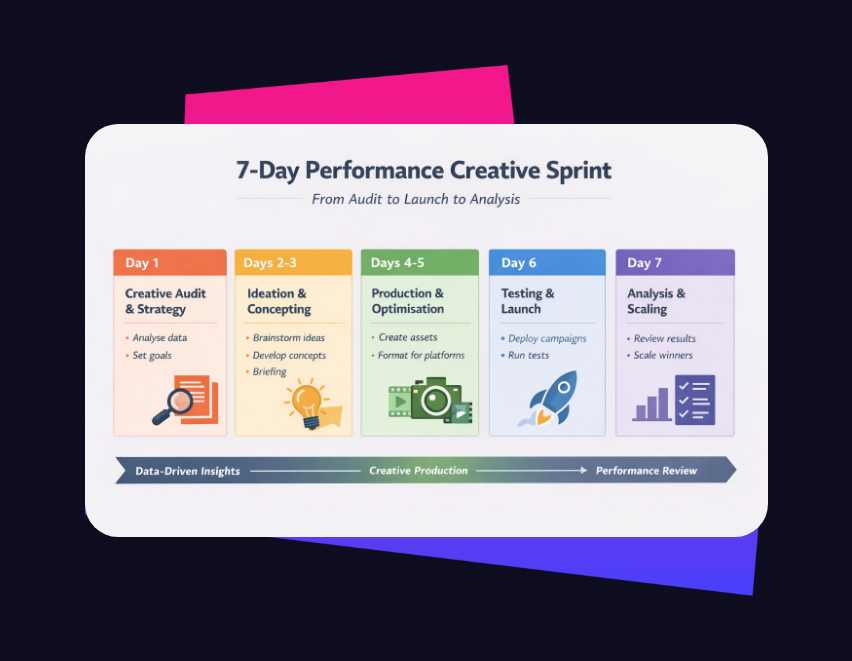
Our 7-day ad sprint planning
Our sprint is designed to be repeatable and scalable. Each day has a clear purpose and output, with performance data shaping decisions throughout.
Day 1. Creative audit and strategic foundation
We start with data and ideas, not just ideas.
The focus is on analysing creative metrics to evaluate performance baselines, identifying fatigue patterns, and understanding where creative gaps exist across the customer journey.
This includes
- Reviewing recent creative performance
- Identifying declining assets and recurring patterns
- Mapping where messaging breaks down
- Analysing competitor ads
The output is a creative ad plan grounded in performance insight, not opinion.
Days 2 to 3. Rapid ideation (ad plan) and briefing
Our ad plan is structured and data-led.
We work across a defined set of creative angles, generating multiple ad concepts within each rather than spreading effort thinly.
These typically include (varies based on creative strategy)
- Problem and solution framing
- Social proof and real-world validation
- Expert authority
- Contrarian messaging
- Outcome-led transformation stories
- Creative briefing for the production teams
Each concept is mapped to a specific context and goal.
As AI-generated content becomes more common, authentic UGC-style creative continues to outperform overly polished brand assets when the underlying insights are strong.
Days 4 to 5. Asset production
Production briefs go out a week ahead, and we typically give the production team a week to film and edit content.
The aim is to ship just enough creatives by next week to learn, not to overbuild before testing.
Key principles include
- Brief-specific execution
- Efficient feedback loops
- Platform-native formats
- Built-in messaging frameworks
Multiple formats are produced per concept, so performance signals can compound quickly.
AI supports the production stage by accelerating scripting, visualisation, and (for the next week) iteration, while strategic decisions remain human-led.
Day 6. Structured testing and launch
Creative is launched with control and clarity.
Key variables are isolated so performance drivers can be identified, not guessed.
Budgets are monitored, audiences are consistent, and learning windows are respected.
Early indicators such as hook rate and engagement quality are monitored alongside conversion signals.
Day 7. Analyse, iterate, and scale
The sprint does not end at launch.
Winning assets are identified, performance patterns are documented, and next-stage iterations are defined.
The budget is reallocated based on data and learnings, typically prioritising proven assets while reserving space for iteration and experimentation.
This is where the system compounds over time.
How AI is reshaping creative production
AI has changed the economics of creative production.
It now plays a role in
- Quicker scripting and editing
- Faster iterations of winning concepts
- Earlier detection of fatigue patterns
What it does not replace is strategic judgement.
The brands seeing sustained performance gains are using AI to remove friction from execution so teams can focus on insight quality, messaging clarity, and differentiation.
Performance creative in an answer-engine world
As answer engines increasingly influence discovery, creative has to work harder earlier in the funnel.
Audiences arrive more informed and more sceptical.
This has shifted performance creative toward
- Education before persuasion
- Authority before urgency
- Explanation before conversion
Longer-form, insight-led creative now plays a meaningful role in warming the audiences before short-form conversion assets do their job.
Why this sprint plan works for us
This sprint plan works because it aligns creative, media, and insight into a single workflow that is designed and optimised to perform over time.
Our sprint plan ensures data-informed, insight-led, idea-rich performance creative is delivered consistently every other week.
Creative fatigue is not something you solve once. It is something you must manage continuously. That is what our sprint plan is designed to do.