The anatomy of a successful growth team in 2026: roles, workflows, and data infrastructure

The growth marketing landscape has transformed beyond recognition. We have witnessed this evolution firsthand, working with ambitious brands that have scaled from startups to market leaders. What is the difference between the brands that thrive and those that plateau? It’s not the budget. It’s not even the product. It’s the structure and sophistication of their growth teams.
Gone are the days when a marketing manager, a Facebook ads specialist, and a bit of hustle could scale a brand to seven figures. In 2026, elite brands operate more like high-performing tech companies, with cross-functional growth teams, sophisticated data infrastructure, and AI-powered workflows.
After orchestrating growth for brands like Heinz to Home (450% e-commerce sales increase), The Gut Stuff (40% increase in purchases), and FIFA (10 million organic views), we have identified the precise anatomy of teams that deliver sustainable, scalable results.
If you’re building or restructuring your growth team or evaluating whether your current agency partner truly understands modern growth architecture, here is the blueprint.
Why traditional marketing teams are failing e-commerce brands
We often see it happen: brands come to us frustrated with their previous agency or in-house team. They’ve been burning cash on ads, but growth has flatlined. The diagnosis is always the same.
Traditional marketing departments were built for a different era. They’re siloed, slow to iterate, and struggle to connect marketing spend to actual revenue. The CMO oversees the brand, performance sits with a separate team, and data lives in scattered platforms that don’t talk to each other.
The result? Wasted ad spend. Disconnected customer experiences. And growth that evaporates the moment you stop pouring money into paid acquisition.
Elite e-commerce brands and performance agencies like ours have abandoned this model entirely. We’ve embraced the growth team structure, a lean, agile, data-driven approach where experimentation, customer lifetime value, and cross-channel orchestration reign supreme.
This isn’t theoretical. This is how we’ve helped clients achieve results like
- 95% client retention (because our approach actually works)
- 178% average yearly growth across our portfolio
- 6.5 average ROAS across accounts
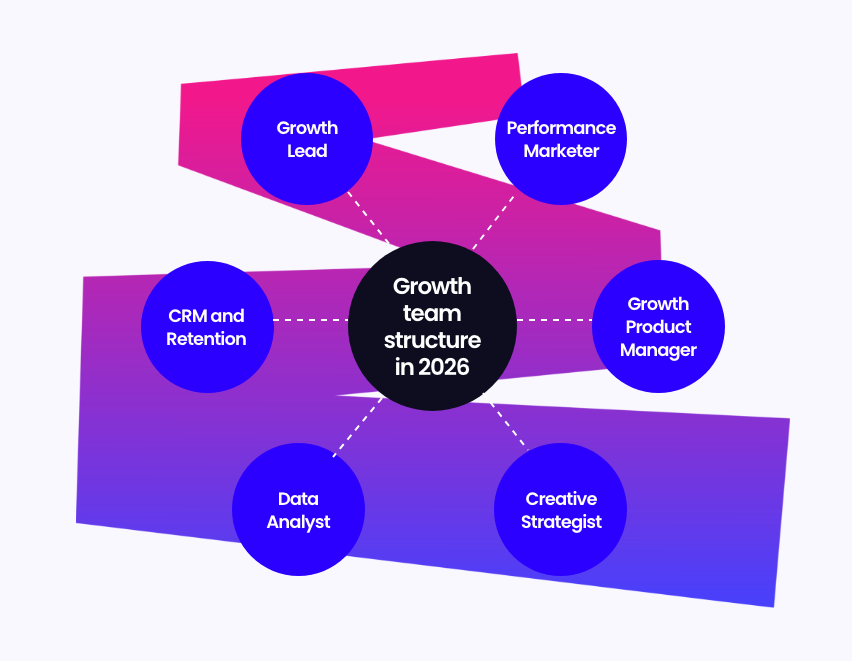
The core structure of how elite growth teams will be organised in 2026
Whether you’re building an in-house team or partnering with an agency (spoiler: the best brands do both), understanding these roles is critical.
1. Growth lead or head of growth
What they do
The strategic architect. They set the growth roadmap, prioritise experiments, and ensure every initiative ladders up to revenue and retention goals.
Key skills in 2026
- Deep understanding of unit economics (CAC, LTV, payback periods)
- Experience with AI and automation tools
- Data fluency (comfortable in analytics dashboards and data warehouses)
- Cross-functional leadership
Why it matters
This role has evolved from ‘run ads and hope for the best’ to ‘orchestrate omnichannel growth engines’. The best growth leads think like product managers: data-driven, metric-obsessed, and ruthlessly focused on ROI.
2. Performance marketing manager
What they do
Owns paid acquisition across Meta, Google, TikTok, and emerging channels. In 2026, this role is less about manual bid adjustments and more about creative strategy, audience insights, and algorithmic collaboration.
Key skills in 2026
- AI-assisted campaign optimisation and predictive analytics
- Creative testing frameworks (static, video, UGC)
- First-party data activation
- Multi-touch attribution modelling
The shift
With AI handling 60%+ of tactical optimisation, performance marketers are now strategists and data interpreters. They understand why campaigns work, not just which buttons to push. It’s precisely why we’ve helped The Gut Stuff increase purchases by 40% while decreasing costs by 30%.
3. CRM and retention specialist
What they do
Owns email, SMS, push notifications, and loyalty programmes. They turn one-time buyers into repeat customers and evangelists.
Key skills in 2026
- Advanced segmentation and predictive modelling
- AI-powered personalisation (dynamic content, send-time optimisation)
- Lifecycle marketing and win-back campaigns
- Cohort analysis and churn prediction
Why retention rules in 2026
With iOS privacy changes and rising CAC, the brands winning today are those obsessed with LTV. A 10% improvement in retention can double your growth trajectory, without spending a penny more on ads. This is where amateur agencies fall short. They chase new customers while ignoring the goldmine of existing ones.
4. Growth product manager
What they do
Bridges marketing and product. Owns the on-site experience, conversion rate optimisation, and growth features (referrals, subscriptions, bundles).
Key skills in 2026
- A/B testing and experimentation frameworks
- UX research and behavioural psychology
- Collaboration with dev teams on growth features
- Analytics (GA4, heatmaps, session recordings)
The unlock
Successful brands realise that growth isn’t just about driving traffic; it’s about converting and retaining it. Driving 100,000 visitors to a site that converts at 1% is far worse than driving 50,000 to a site that converts at 3%. This role ensures every pound spent on acquisition has maximum impact.
5. Data analyst or growth analyst
What they do
The truth-teller. They build dashboards, model attribution, and uncover insights that inform every decision the growth team makes.
Key skills in 2026
- SQL and data visualisation tools (Looker, Tableau, Mode)
- Statistical analysis and experimentation design
- Customer data platform (CDP) management
- Predictive analytics and machine learning basics
Why is this role important
In 2026, data isn’t just nice to have; it’s your competitive moat. Brands that can measure incrementality, attribute revenue accurately, and predict customer behaviour are light-years ahead of those flying blind. If your current agency can’t explain exactly which channels and campaigns are driving profitable revenue, you’re working with the wrong partner.
6. Creative strategist
What they do
Drives the creative engine. Produces scroll-stopping ads, landing pages, and content that resonates emotionally while converting commercially.
Key skills in 2026
- AI-assisted creative production (generative tools, rapid prototyping)
- Platform-native storytelling (TikTok, Reels, YouTube Shorts)
- UGC sourcing and creator partnerships
- Creative analytics (understanding which ad, formats, and messages perform)
The evolution
Creative is no longer a subjective art; it’s a testable science. The best creative strategists in 2026 operate like growth hackers, running 50+ creative tests per month and doubling down on winners.
7. Growth engineer
What they do
Builds the tech stack and automates workflows. They’re the glue between marketing tools, data pipelines, and growth initiatives.
Key skills in 2026
- API integrations and no-code or low-code tools (Zapier, Make, Retool)
- Tag management and event tracking (GTM, Segment)
- Basic front-end development (HTML, CSS, JavaScript for landing pages)
- AI tool implementation and prompt engineering
Why do you need this role
The modern growth stack has 15-30 tools. Without a growth engineer, your team drowns in manual processes, broken integrations, and incomplete data. This role unlocks speed and scale.
The ideal team size for different growth stages
Startup (£0–1M revenue)
Recommended structure
Partner with a specialist performance agency to access full-stack growth expertise without the overhead of multiple senior hires.
Core needs
- Strategic partner managing paid acquisition and retention
- Fractional growth lead, often agency-side
- Internal brand or content owner
- Freelance creative support
Why this works
Early-stage brands need speed, learning velocity, and senior thinking without committing to a heavy payroll. This model provides breadth, experience, and execution while preserving cash flow.
Scale-up (£1M–10M revenue)
Recommended structure
Hybrid model with internal strategic leadership supported by specialist agency execution.
Core team
- Head of growth
- Performance marketing manager
- CRM and retention manager
- Agency partner for execution
- Data analyst
- Creative strategist
- Growth engineer
Why this works
This stage demands tighter ownership and deeper brand context, while still benefiting from specialist depth and execution capacity. Agencies function best here as embedded partners, not external vendors.
Established (£10M+ revenue)
Recommended structure
Primarily in-house growth team, supported by agencies for specialist channels, innovation, and overflow.
Core team
- VP of growth
- Performance marketing team (3–5 in-house)
- Retention marketing team (2–3 in-house)
- Growth product team (2–3 in-house)
- Data and analytics team (2+ analysts)
- Creative team (2–3 in-house strategists plus external creators)
- Marketing technology manager
- Agency partners for specialist and experimental initiatives
Why this works
At scale, internal capability is essential. Agencies remain valuable for external perspective, pattern recognition across accounts, and rapid execution during peak demand or channel expansion.
The workflows that separate elite teams from the rest
We have refined these workflows across hundreds of client engagements. Here’s what actually works.
Weekly growth plan
Monday
Sprint planning. Review OKRs, prioritise experiments, and align on the week’s focus. For our clients, this is when we present the week’s strategy and get alignment.
Wednesday
Mid-week check-in. Assess live campaigns, address blockers, and adjust tactics. We flag opportunities and risks, no waiting until Friday to discover a budget burned on underperforming creative.
Friday
Learning review. Analyse completed ad performance, document insights, and plan next tests. This is where we turn data into institutional knowledge.
Testing cadence
Elite teams run 8-15 ad tests per month across channels. We follow a rigorous process
Idea formation (based on data, not gut feel)
Experiment design (clear success metrics and test parameters)
Execution (speed matters, launch fast, iterate faster)
Analysis (statistical significance plus qualitative insights)
Documentation (build an institutional knowledge base)
Cross-functional collaboration
Growth doesn’t happen in a silo. Elite teams have
- Weekly syncs between agency and internal stakeholders (we align on brand, product launches, and strategic priorities)
- Bi-weekly creative reviews (our performance marketers and creative strategists dissect what’s working and why)
- Monthly business reviews (presenting growth metrics, forecasts, and strategic recommendations to leadership)
The data infrastructure powering successful brands
Data infrastructure isn’t considered important until it’s the reason your competitor is scaling profitably while you’re burning cash on guesswork. We insist that clients have proper foundations. Here’s the modern growth stack we implement.
- Customer data platform (CDP)
Examples
Segment, mParticle, RudderStack
Why it’s essential
Unifies customer data from your website, app, email, ads, and warehouse into a single source of truth. Enables real-time personalisation and accurate attribution.
Our approach
For most B2C brands, we implement Segment or Klaviyo’s CDP capabilities, depending on scale and budget. - Data warehouse
Examples
Snowflake, BigQuery, Redshift
Why it’s essential
Centralised storage for all your marketing, product, and revenue data. Powers advanced analytics, custom dashboards, and predictive models.
Our approach
We help clients set up BigQuery (cost-effective for most) and build the pipelines that feed it. This is where we unlock attribution modelling that actually works. - Business intelligence (BI) tools
Examples
Looker, Tableau, Metabase, Google Data Studio
Why it’s essential
Visualises data so teams can monitor performance, spot trends, and make decisions fast. No more waiting days for an analyst to pull a report.
Our approach
We build custom dashboards showing real-time ROAS, CAC, LTV, and contribution margin by channel. Our clients always know exactly where they stand. - Attribution and analytics platform
Examples
Google Analytics 4, Triple Whale, Northbeam, Rockerbox
Why it’s essential
Tells you which channels, campaigns, and creatives are actually driving revenue. In 2026, multi-touch attribution and incrementality testing are non-negotiable.
Our approach
Proper GA4 implementation (most brands get this wrong), enhanced with a platform like Triple Whale for DTC-specific insights. We also run holdout tests and geo-experiments for true incrementality measurement. - AI and automation layer
Examples
ChatGPT API, Claude, Make.com, Zapier, Supermetrics
Why it’s essential
Automates repetitive tasks (data pulls, reporting, creative variations) and augments decision-making with predictive insights.
Our approach
We use AI to automate reporting, generate creative variations, analyse sentiment, and predict customer behaviour. This efficiency is how we deliver enterprise results without enterprise retainers. - Experimentation and personalisation platform
Examples
Optimizely, VWO, Dynamic Yield, Convert
Why it’s essential
Enables A/B testing, multivariate testing, and personalised experiences at scale. Turns your website into a constantly improving revenue machine.
Our approach
Integrated CRO is part of our web design service. We build sites on Shopify and custom platforms with testing built in from day one. That 63% average conversion rate uplift? It comes from relentless experimentation. - CRM and lifecycle marketing platform
Examples
Klaviyo (DTC), HubSpot (B2B), Iterable, Braze
Why it’s essential
Powers email, SMS, and push campaigns with advanced segmentation, automation, and AI-driven personalisation.
Our approach
As Klaviyo partners, we architect retention strategies that turn one-time buyers into brand evangelists. We’ve helped brands increase email-attributed revenue by 40-80% through proper segmentation and flow optimisation.
The AI revolution: how automation is reshaping growth teams
AI isn’t a buzzword anymore; it’s a competitive advantage. Here’s how we’re leveraging AI to deliver better results, faster.
- Creative production
AI-generated ad variations (text, images, video concepts)
Automated A/B testing of hooks and calls to action
Predictive analysis of which creative concepts will perform before spending a penny - Campaign optimisation
Algorithmic bid management with strategic human oversight
Predictive audience expansion based on LTV models
Real-time budget reallocation across channels and campaigns - Customer insights
Churn prediction models identify at-risk customers
LTV forecasting informs acquisition strategies
Sentiment analysis from reviews, support tickets, and social media - Operational efficiency
Automated reporting and dashboard creation (saving 20+ hours weekly)
AI assistants summarising campaign performance and recommending actions
Predictive alerting when campaigns underperform or opportunities emerge - The human edge
While AI handles tactical execution and data crunching, elite agencies provide the strategic thinking, creative intuition, and high-stakes decision-making AI can’t replicate. AI is used to be faster and smarter, not to replace expertise.
The future of growth teams! What’s coming next
Looking beyond 2026, here’s what we are preparing clients for.
Hyper-personalisation at scale
AI-driven one-to-one experiences across email, site, and ads. Every customer sees a unique journey optimised for their behaviour and preferences.
Predictive growth models
Machine learning forecasts revenue, churn, and LTV with 90%+ accuracy. Growth teams will shift from reactive to proactive, stopping churn before it happens.
Voice and conversational commerce
Growth teams optimising for voice search, AI shopping assistants, and conversational interfaces. We are already testing this for forward-thinking clients.
Privacy-first growth
With third-party cookies gone and regulations tightening, first-party data strategies and privacy-preserving attribution will dominate. Brands that haven’t invested here will be blind.