
Blog Archives - Pixated

PPC Agency Guide: How to Choose & What to Expect

Table of Contents

PPC Agency Guide: How to Choose & What to Expect

Last Updated: July 22, 2026

What Is a PPC Agency and How Does It Work?

A ppc agency is a specialized marketing firm that manages paid advertising campaigns across search engines, social platforms, and display networks on behalf of brands. Unlike in-house teams juggling multiple responsibilities, a ppc agency dedicates specialized expertise to optimizing every dollar you invest in paid media.

A functional ppc agency treats your account like a living system, continuously testing ad copy, refining keyword targeting, adjusting bid strategies, and analyzing performance data to find what moves the needle for your business. The core difference between managing PPC yourself and hiring an agency comes down to time, expertise, and scale. Most businesses underestimate how much attention a high-performing PPC account demands.

Pro Tip
The best PPC agencies don’t just promise results, they show you exactly how they’ll achieve them. Ask any prospective ppc agency to walk you through their optimization process before signing. If they can’t explain it clearly, that’s a red flag.

Core Responsibilities of a PPC Agency

A legitimate ppc agency manages account architecture, keyword research, bid strategy, landing page optimization, conversion tracking, and continuous performance analysis. Account setup and structure form the foundation, a ppc agency builds your account to scale by organizing campaigns by product line, customer segment, or marketing funnel stage. Poor structure limits your ability to identify what’s working; a well-structured account lets you see exactly which keywords, audiences, and offers drive conversions.

Bid management is critical. Your ppc agency adjusts bids based on conversion data, time of day, device type, and other signals. The best ppc agencies use automated bidding strategies like target CPA and target ROAS that respond to market conditions in real time.

Landing page optimization often gets overlooked. A ppc agency doesn’t just send traffic to your homepage, they create targeted landing pages that match ad intent. A visitor searching "affordable accounting software for startups" lands on a page about startup accounting, not a generic product overview. This alignment between ad promise and landing page reality separates a 2% conversion rate from an 8% one.

Platforms PPC Agencies Manage

Most ppc agencies focus on Google Ads as their primary platform due to search volume dominance. A comprehensive ppc agency also manages Google Shopping, Google Display Network, Bing Ads, Facebook Ads, Instagram Ads, LinkedIn Ads, TikTok Ads, and Amazon Ads for e-commerce brands.

Each platform has different mechanics and audience behaviors. The best agencies specialize deeply in 2-3 platforms and manage others competently. Google Ads dominates because of search intent, when someone types "PPC management services," they’re actively looking for a solution, and that intent-driven traffic converts at higher rates. Bing Ads reaches a different demographic (older, wealthier, often professional) and sometimes offers lower competition and better ROI for B2B brands.

Social advertising (Facebook, Instagram, LinkedIn, TikTok) works differently, reaching people based on interests and behaviors rather than search queries. A ppc agency using social platforms focuses on retargeting, brand awareness, and audience testing. Amazon Ads have become critical for e-commerce brands, with a ppc agency optimizing product listing ads, sponsored brands, and sponsored display campaigns.

Benefits of Hiring a PPC Agency

The decision to hire a ppc agency comes down to ROI. You’re paying agency fees to save time and generate better results than you could in-house. If an agency can’t demonstrate both benefits, you’re throwing money away.

Expertise and Campaign Optimization

Running profitable PPC campaigns requires expertise that takes years to develop. A professional ppc agency has seen thousands of accounts, tested hundreds of strategies, and knows what works in your industry. Campaign optimization is where expertise shows itself, the difference between a 1.5:1 return on ad spend and a 3:1 return isn’t luck, it’s methodical testing and analysis.

A ppc agency tests ad variations, landing pages, audience segments, and bid strategies simultaneously. They interpret data correctly, knowing which changes are statistically significant and which are noise. Keyword research separates amateurs from professionals. A ppc agency finds high-intent keywords with low competition, identifies negative keywords that waste budget, and spots seasonal opportunities you’d miss.

Key Takeaway
The real value of a ppc agency isn’t the hours worked, it’s the optimization decisions they make based on data. Those decisions compound over time, turning a mediocre account into a profit machine.

Time Savings and Scalability

Managing PPC in-house demands consistent daily attention. Accounts need monitoring, budgets shift, competitors change bids, and seasonality affects performance. A single person managing PPC while handling other responsibilities inevitably falls behind.

A ppc agency scales your efforts without scaling your headcount. As your business grows and you add new products or markets, the agency expands the account structure to match. Time savings extend beyond daily management, a ppc agency handles reporting, analytics setup, conversion tracking, and performance analysis, freeing your internal team to focus on strategy and business development.

PPC Management Services Offered by Agencies

Not all ppc agencies offer the same services. Some focus narrowly on Google Ads while others bundle in landing page design, copywriting, and conversion rate optimization.

Account Strategy and Setup

Before launching a single ad, a ppc agency builds strategy by understanding your business model, target customers, competitive landscape, and revenue goals. A competent ppc agency asks critical questions: What’s your current customer acquisition cost? What’s your average customer lifetime value? Which customer segments are most profitable?

These answers inform account structure. A ppc agency might recommend focusing on high-intent keywords first, building volume in profitable segments before testing new audiences. Account setup involves creating campaigns, ad groups, and keyword lists organized so performance data tells a clear story. Conversion tracking setup is critical, a ppc agency ensures every conversion is properly tracked back to the ad that drove it. Without accurate tracking, you can’t know which campaigns are profitable.

Ongoing Optimization and Reporting

After launch, a ppc agency continuously analyzes performance data and makes optimization decisions. They test different ad copy variations, adjust keyword bids based on conversion data, pause underperforming campaigns, and scale winners.

Good reporting isn’t a dashboard full of metrics, it’s a clear narrative explaining what was tested, what worked, what’s being tested next, and how ROI changed. A ppc agency should explain performance in business terms (revenue, profit, customer acquisition cost) not just marketing metrics. Monthly optimization cycles are standard, with weekly data reviews and strategic decisions made monthly.

PPC Keyword Research and Campaign Structure

Keyword research is where most in-house PPC programs fail. Teams bid on obvious keywords, miss high-intent opportunities, and waste budget on irrelevant traffic. A ppc agency approaches keyword research systematically.

Building Effective Account Architecture

Account architecture determines what data you can see and how effectively you can optimize. A poorly structured account hides problems; a well-structured account reveals exactly where money is being made and lost.

The best ppc agencies organize campaigns around business logic. For an e-commerce brand selling multiple product lines, campaigns might be organized by product category with ad groups for specific product types. This structure lets you answer critical questions: "What’s the ROI on our shoe category?" "Which product type has the highest conversion rate?" Negative keywords are equally important, a ppc agency identifies search terms that waste budget and don’t convert.

Account Element Purpose Impact
Campaign structure Organize by business logic (product, audience, geography) Enables clear performance visibility and budget allocation
Ad group organization Group tightly themed keywords together Improves ad relevance and quality score
Negative keywords Exclude irrelevant searches Reduces wasted spend and improves ROAS
Bid strategy Automate or manual based on data Optimizes for conversion value or volume
Landing pages Match ad intent with page content Increases conversion rates and quality score

Cost of PPC Agency Services: What to Budget

Pricing is where many brands get confused about ppc agencies. Understanding the true cost of PPC management requires looking beyond the invoice and calculating total ROI.

Pricing Models and Fee Structures

A percentage-of-spend model aligns incentives but can get expensive. If an agency takes 15% of ad spend and you’re spending $50,000 monthly, the agency fee is $7,500. As your business scales, agency fees increase proportionally. This works well if the agency is genuinely scaling your ROI, they only make more money if you make more money.

Flat-fee models work for businesses with predictable, stable ad spend. A ppc agency might charge $3,000-$10,000 monthly depending on account complexity, regardless of how much you spend. This works well if you have a set budget and want predictable costs.

Hybrid models combine a base fee with performance incentives. An agency might charge $2,000 monthly plus a bonus if they exceed ROAS targets. This balances stability with incentive alignment.

Pricing Model Comparison:

Model Monthly Cost (Example) Best For Incentive Alignment
% of spend (15%) $7,500 on $50K spend Scaling businesses High, agency profits when you profit
Flat fee $5,000/month Stable budgets Low, no incentive to scale
Hybrid ($2K + 5% of spend) $4,500 on $50K spend Balanced approach Medium, base covers costs, bonus incentivizes growth

The critical question isn’t the pricing model, it’s whether the ppc agency delivers ROI greater than their fees. If an agency costs $5,000 monthly but generates an extra $50,000 in profit, that’s a 10:1 return.

In-House vs. Agency: A Rigorous Cost-Benefit Analysis

The decision between in-house PPC management and hiring a ppc agency requires comparing total cost of ownership, not just salary versus fees.

The In-House Option: Full Cost of Ownership

A mid-level PPC specialist in the US earns $70,000-$100,000 annually. Add 25-30% for benefits, and total compensation is $87,500-$130,000 per year, or roughly $7,300-$10,800 monthly. Add software tools ($200-$500 monthly), training ($1,000-$2,000 annually), and overhead (15-20% of salary).

Total monthly cost of one in-house PPC specialist: $8,500-$12,500.

The bigger hidden cost is opportunity cost and bottleneck risk. One person managing PPC is a single point of failure. If they leave, you’re scrambling. They can only work 40 hours per week. They have limited perspective, they’ve only managed your accounts, not thousands across industries.

The Agency Option: Distributed Expertise

A ppc agency costs $5,000-$15,000 monthly depending on account size and complexity. What you get: specialized expertise from multiple team members, scale without hiring, accountability, perspective from other industries, and no management overhead.

The ROI Comparison: Where the Real Difference Shows

Scenario: E-commerce brand with $100,000 monthly ad spend

In-house option:

  • Monthly cost: $10,000
  • ROAS achieved: 2.5:1
  • Monthly profit from ads: $150,000 (after ad spend)
  • Net profit after specialist cost: $140,000

Agency option:

  • Monthly cost: $8,000 (8% of spend)
  • ROAS achieved: 3.5:1
  • Monthly profit from ads: $250,000 (after ad spend)
  • Net profit after agency fee: $242,000

The agency option generates $102,000 more monthly profit ($1.22M annually), despite costing $2,000 less per month.

Decision Framework: When to Choose Each Option

Choose in-house if:

  • Your ad spend is under $30,000 monthly and stable
  • You have deep domain expertise and can manage a specialist effectively
  • You need direct control over account decisions
  • You’re willing to accept slower optimization and limited perspective

Choose an agency if:

  • Your ad spend is over $30,000 monthly or growing rapidly
  • You lack PPC expertise and need specialized knowledge
  • You want access to multiple specialists
  • You value accountability and the ability to switch if performance drops
  • You want your internal team focused on strategy and business development
Watch Out
The biggest mistake brands make is comparing agency cost to salary alone. A $5,000 monthly agency fee seems expensive until you realize an in-house hire would cost $10,000 monthly and generate worse results. Always compare ROI, not just cost.

Questions to Ask About Agency Pricing

Before committing to an agency, clarify what’s included in the fee, what costs extra, how the fee is calculated, what happens if ad spend changes, whether there are performance minimums or maximums, contract terms, and how success is measured. The right pricing model is one where both you and the agency profit when your business grows.

How to Choose the Right PPC Agency

Hiring the wrong ppc agency wastes money and damages your brand. A structured evaluation process reduces risk and ensures you’re selecting an agency aligned with your business goals.

The PPC Agency Evaluation Checklist

Create a weighted scorecard before evaluating agencies. Assign points to criteria that matter most:

Industry Experience (25 points): Does the agency have documented case studies in your specific industry? Ask for references in your exact vertical.

Technical Capability (20 points): Can they manage the platforms you need? Request a technical audit of your current account. Their recommendations should be specific, not generic.

Reporting and Transparency (20 points): Request a sample report. Is it a dashboard dump or a narrative? Ask how often you’ll communicate and whether you have direct access to your Google Ads account.

Team Structure and Continuity (15 points): Who will manage your account day-to-day? What happens if your account manager leaves? Ask about account manager tenure and turnover rates.

Pricing Alignment (10 points): Does their pricing model align with your goals? Avoid agencies that won’t discuss pricing transparently or that require long-term contracts with exit penalties.

Questions That Separate Good Agencies from Great Ones

Ask the ppc agency to walk you through their actual process, not their methodology. "Here’s how we structure accounts for a business like yours. Here’s our keyword research process. Here’s how we test ad copy." If they can’t articulate a clear process, they don’t have one.

Ask about their approach to your specific challenge. Ask how they handle budget constraints and their testing philosophy. A strong answer includes a testing roadmap showing systematic approach, not reactive decisions.

Red Flags and What to Avoid

Avoid agencies that promise guaranteed results. No legitimate ppc agency guarantees a specific ROAS or CPA. Avoid agencies that don’t ask questions about your business before proposing strategy. Avoid agencies that won’t discuss fee structure transparently or that resist discussing ROI expectations. Avoid agencies that don’t provide transparent reporting or restrict your access to your own Google Ads account. Avoid agencies that don’t test and iterate continuously. Avoid agencies that claim expertise in all platforms equally.

The Reference Call: What to Ask

When an agency provides references, ask specific questions: What was your ROAS before and after? How long until you saw improvement? What surprised you about working with this agency? Did they communicate proactively? Would you hire them again?

Ask for references from at least two clients in your industry and one from a different industry. Ask for references from clients with similar budgets to yours.
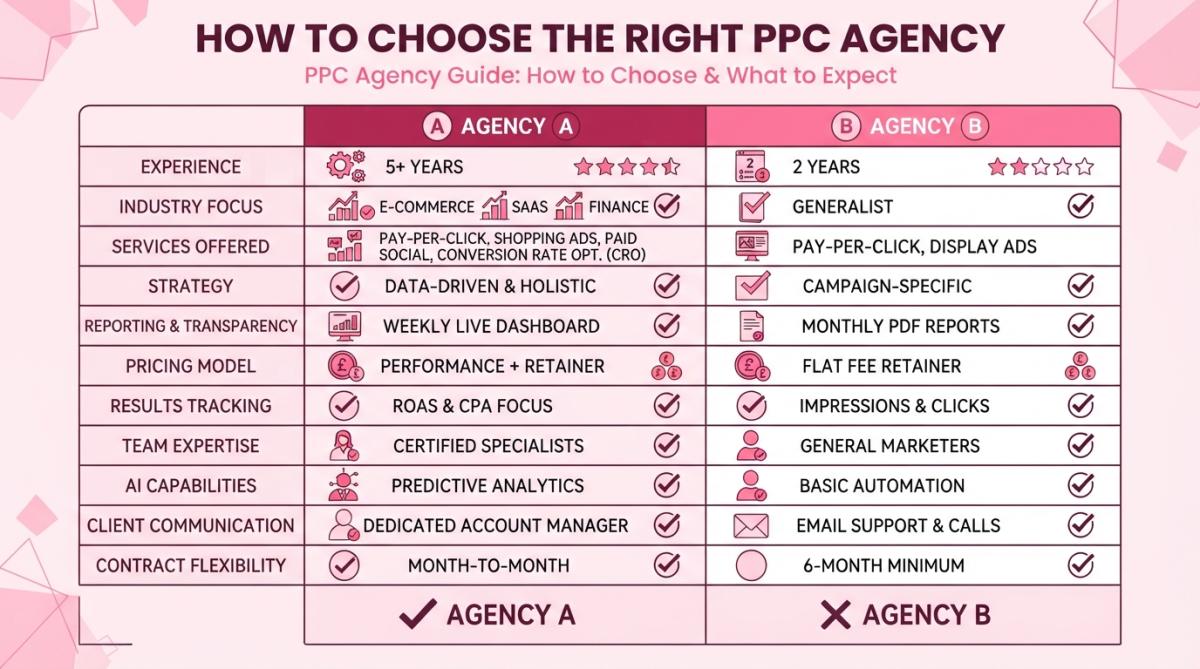
Side-by-side comparison of PPC agency evaluation criteria on a spreadsheet with checkmarks and ratings

AI and Automation in Modern PPC Agencies

The PPC landscape is shifting toward automation and AI-driven optimization. The best ppc agencies today use machine learning to predict customer behavior and optimize campaigns at scale.

Modern automation is sophisticated. Google’s Performance Max campaigns use machine learning to optimize across all Google channels simultaneously. Facebook’s Advantage+ campaigns automatically test audiences, placements, and creative variations.

A forward-thinking ppc agency embraces automation, understanding that machines are better at processing data and finding patterns than humans. They use automation for repetitive tasks and focus their expertise on strategy and creative testing.

AI is changing how ppc agencies approach keyword research, ad copy, and landing page optimization. AI tools can analyze competitor ads, identify messaging gaps, and suggest copy variations. They can predict which keywords will convert before you bid on them.

The risk of AI in PPC is over-reliance. Some agencies use AI to completely automate campaign management, reducing human oversight. The best ppc agencies combine machine learning with strategic thinking, creative testing, and business acumen.

Contractual Transparency and Accountability

A contract with a ppc agency should be clear about what you’re getting, what success looks like, and what happens if performance drops.

What to Look for in an Agency Agreement

The contract should specify deliverables. Not vague promises but concrete deliverables: "We’ll manage your Google Ads account, test at least two ad variations per week, optimize keywords and bids daily, provide monthly reporting, and maintain a minimum account structure of X campaigns."

Performance metrics should be defined. What are you measuring success against? ROAS? CPA? Revenue? The contract should specify the baseline and target, plus the timeframe for improvement.

Payment terms matter. Is the fee fixed or variable? When is it due? What happens if you want to pause or cancel? A good ppc agency doesn’t lock you into long-term contracts with exit penalties.

Communication cadence should be outlined. How often will you hear from the agency? What will meetings cover? What’s the process for requesting changes?

Account ownership should be clear. You own your Google Ads account. The ppc agency manages it on your behalf, but you retain ownership and can access it anytime. If you leave, you can take the account with you.

Measuring Success: PPC Audit and Performance Metrics

You can’t optimize what you don’t measure. A good ppc agency measures everything and explains what the numbers mean.

Key Performance Indicators and ROI Tracking

The metrics that matter depend on your business model. An e-commerce brand cares about revenue and profit. A B2B SaaS company cares about qualified leads. A service business cares about bookings. A ppc agency should measure success in your business metrics, not marketing metrics.

Cost per acquisition (CPA) is critical. If your CPA is $50 and your average customer lifetime value is $500, you have a healthy 10:1 ratio. A ppc agency should optimize toward target CPA.

Return on ad spend (ROAS) measures revenue generated per dollar spent on ads. A 2:1 ROAS means for every dollar spent, you generate two dollars in revenue. A 3:1 ROAS is better. But ROAS doesn’t account for profit margins or customer lifetime value. A ppc agency should understand the difference between revenue and profit.

Conversion rate is important but often misleading. A landing page with a 5% conversion rate might be better than one with a 3% conversion rate, but if the 3% page attracts higher-value customers, it might be more profitable. A ppc agency looks at conversion rate in context of customer value.

Quality score is Google’s rating of your ads and landing pages. Higher quality scores mean lower costs and better ad positions. A ppc agency should maintain quality scores above 7/10. Click-through rate (CTR) measures how many people click your ads. Higher CTR usually means better ad copy, but CTR alone doesn’t indicate success. A ppc agency uses CTR as a diagnostic tool, not a success metric.


Choosing a ppc agency is one of the highest-impact decisions a growing brand can make. The right agency compounds your growth, turning ad spend into sustainable profit. Focus on finding a ppc agency that demonstrates clear expertise in your industry, communicates transparently about strategy and results, and ties their success to your revenue growth. The best partnerships align incentives, prioritize ROI, and deliver measurable results.

Frequently Asked Questions

What does a PPC agency do?

A PPC agency manages your pay-per-click advertising across platforms like Google Ads, Bing Ads, and social media channels. They handle keyword research, ad copy creation, bid management, landing page optimization, and continuous campaign optimization to improve your conversion rate and ROI. They also provide analytics and performance reporting to track results.

How much does a PPC agency cost?

PPC agency pricing depends on your ad spend volume, campaign complexity, industry, and the services included. Pricing models vary, some charge a percentage of your ad spend, others use flat fees or performance-based models. To get accurate pricing tailored to your specific needs and budget, contact agencies directly for a custom quote.

What benefits of hiring a PPC agency should I expect?

Key benefits include expert campaign optimization that improves conversion rates, professional ad management that saves internal time, access to advanced tools and analytics, strategic keyword research and bid management, and scalability as your business grows. Agencies bring specialized expertise in landing page optimization, A/B testing, and ROI-driven strategies that often deliver better results than in-house management.

How do I know if a PPC agency is right for my business?

Evaluate agencies based on their experience with your industry, transparent reporting practices, clear contractual terms, and willingness to answer detailed questions about strategy. Ask for case studies, references, and specifics on how they'll improve your current performance. Red flags include vague promises, pressure to sign long contracts, or reluctance to discuss metrics and accountability.

What questions should I ask a PPC agency before hiring?

Ask about their experience with your industry and business model, how they approach PPC keyword research and account structure, what tools they use, how they report results, their typical contract length and exit terms, and specific examples of how they've improved ROAS for similar clients. Request clarity on fee structure, who manages your account day-to-day, and how they handle communication.

What are red flags when choosing a PPC agency?

Watch for agencies that guarantee results, avoid discussing your specific metrics or goals, pressure you into long-term contracts without clear performance benchmarks, use boilerplate strategies without customization, lack transparency in reporting, or disappear after initial setup. Also be cautious if they can't explain their approach to bid management, landing page optimization, or A/B testing in detail.

Should I hire a PPC agency or manage campaigns in-house?

In-house management offers direct control and lower ongoing costs but requires hiring skilled staff, investing in tools, and dedicating significant time to stay current with platform changes. Agencies provide expertise, scalability, and access to advanced tools, but involve higher fees and less direct control. Choose based on your budget, team capacity, and whether you have the expertise to optimize campaigns for conversion rate and ROI.

This article was written using GrandRanker

Meta Ads Agency: The Complete 2026 Hiring Guide

Table of Contents

Last Updated: July 22, 2026

What Is a Meta Ads Agency?

A meta ads agency is a specialized marketing firm that manages paid advertising campaigns across Meta’s platforms, Facebook, Instagram, Threads, and Audience Network. These agencies handle everything from strategy and creative development to campaign execution and performance optimization. At Pixated, we work with brands to build sustainable growth through AI-powered Meta advertising strategies that move beyond vanity metrics to focus on measurable business outcomes.

Unlike generalist digital marketing agencies, a meta ads agency brings deep expertise in Meta’s algorithm, pixel tracking, attribution modeling, and conversion optimization. They understand how to navigate Meta’s increasingly complex platform changes, iOS privacy updates, and the shift toward first-party data collection. The agencies that succeed today are those that combine technical proficiency with creative strategy, they don’t just spend budget, they engineer results.

The role has evolved significantly. Five years ago, a meta ads agency might have focused primarily on audience targeting and bid optimization. Today, the best agencies integrate paid media with organic content strategy, user-generated content (UGC), and landing page conversion rate optimization (CRO). They treat Meta advertising as one component of a full-funnel growth strategy rather than an isolated channel.

According to eMarketer’s 2026 social advertising report, Meta platforms account for over 20% of global digital ad spending. That concentration of budget means the stakes are high, a poor agency choice can drain resources quickly, while the right partner can unlock exponential growth.

Key Services Meta Ads Agencies Provide

Campaign Strategy & Setup

The foundation of any successful Meta advertising effort starts with strategy. A competent meta ads agency doesn’t jump straight into launching ads. Instead, they audit your current situation, define clear business objectives, and map out how Meta advertising fits into your broader growth goals.

Campaign strategy includes audience research and segmentation. The agency identifies who your ideal customers are, where they spend time on Meta platforms, and what messaging resonates with them. They build custom audiences based on your first-party data, create lookalike audiences to expand reach, and establish retargeting sequences for users who’ve already engaged with your brand.

Setup involves technical configuration that most in-house teams overlook. This includes proper pixel implementation, Conversions API setup for server-side tracking, event validation, and testing. A meta ads agency ensures your attribution data flows cleanly so you can trust your performance metrics. Without this foundation, all optimization efforts are built on sand.

The strategic phase also includes competitive analysis. The agency benchmarks your performance against industry standards, identifies gaps in your approach, and recommends positioning adjustments. They determine which campaign types, conversion campaigns, catalog sales, lead generation, or traffic, align with your business model and growth stage.

Pro Tip
The best agencies ask hard questions before they start spending. If an agency proposes a budget and creative strategy in your first call, that’s a red flag. Real strategy requires understanding your business model, customer acquisition cost targets, and why previous campaigns succeeded or failed.

Ad Creative Development

Creative is where most campaigns live or die. Meta’s algorithm prioritizes engaging content, and the platform’s users scroll past thousands of ads daily. A meta ads agency either creates original creative in-house or manages a network of freelance creators to produce the assets your campaigns need.

Effective Meta creative follows specific principles. It stops the scroll, usually within the first three seconds. It speaks directly to the audience’s pain point or desire. It shows the product or result, not just the brand logo. And critically, it tests multiple variations simultaneously so you can identify what actually resonates rather than guessing.

Creative strategy differs by objective. A conversion campaign for e-commerce needs product-focused creative with clear pricing and urgency signals. A lead generation campaign for B2B SaaS needs to position the solution as easy, credible, and relevant to a specific job title. A brand awareness campaign can afford to be more experimental and emotional.

The best meta ads agencies produce creative at scale. They don’t create one ad and hope it works. They build 10-20 variations testing different hooks, formats, copy angles, and visual styles. They use A/B testing frameworks to identify winning patterns, then iterate on those winners. This systematic approach to creative development is what separates agencies that generate results from those that waste budget.

Conversion Rate Optimization

Paid media without landing page optimization is like pouring water into a leaking bucket. A meta ads agency worth hiring doesn’t just drive traffic, they ensure that traffic converts. This is where CRO comes in.

CRO involves testing and refining every element of your conversion funnel. For e-commerce brands, this means optimizing product pages, checkout flow, and post-purchase experience. For SaaS companies, it’s improving landing pages, form completion rates, and demo booking flows. The agency identifies friction points, where users drop off, and runs experiments to reduce that friction.

Common CRO tactics include simplifying forms, removing unnecessary fields, adding trust signals like testimonials and guarantees, and improving page load speed. The agency also tests headline variations, call-to-action (CTA) copy, and visual hierarchy. Even small improvements, reducing form fields from five to three, for example, can increase conversion rates by 15-25%.

The relationship between a meta ads agency and your CRO efforts should be tight. The agency’s media team feeds conversion data back to the product team. They identify which audience segments convert best and why. They test new landing page variations that the media team can then promote to high-intent audiences. This feedback loop is what drives sustainable growth.

Meta Ads Strategy: Building Your Full-Funnel Approach

Most brands approach Meta advertising reactively. They run a conversion campaign, watch the cost per acquisition (CAC) climb, then pause spending and wonder why it didn’t work. A real meta ads agency thinks in terms of full-funnel strategy.

Full-funnel advertising means addressing customers at every stage of their journey. At the top of the funnel, you’re building awareness with broad audiences who don’t know your brand exists. Middle-funnel campaigns retarget users who’ve engaged with your content but haven’t converted. Bottom-funnel campaigns target high-intent users ready to buy.

This approach matters because not every customer is ready to convert on day one. Someone who sees your product for the first time might need three to five additional touchpoints before they’re confident enough to make a purchase. A fragmented approach, only running conversion campaigns, misses these users and leaves money on the table.

A comprehensive full-funnel strategy typically includes:

  • Awareness campaigns using video or carousel ads to reach broad audiences and build brand familiarity
  • Consideration campaigns targeting engaged users with educational content, comparisons, or customer testimonials
  • Conversion campaigns targeting high-intent audiences with direct purchase or lead generation offers
  • Retention campaigns targeting existing customers with upsell, cross-sell, or loyalty messaging

The budget allocation across these stages depends on your business model. E-commerce brands might allocate 30% to awareness, 30% to consideration, and 40% to conversion. B2B SaaS companies often need more top-funnel investment because their sales cycle is longer and their addressable market is smaller.

A meta ads agency that understands full-funnel strategy doesn’t just optimize for short-term conversions. They build campaigns designed to compound over time. Early awareness campaigns build audience lists. Those audiences become retargeting pools for conversion campaigns. Successful customers become lookalike seeds for finding similar prospects. This systematic approach is what separates agencies that drive sustainable growth from those that create short-term spikes.

Meta Ads Creative: Why It Makes or Breaks Your Campaigns

You can have perfect targeting and flawless optimization, but if your creative doesn’t engage, your campaign fails. Meta’s algorithm prioritizes user engagement above almost everything else. An ad with high click-through rate (CTR) and low cost per click (CPC) signals quality to the system, and the algorithm rewards it with lower costs and broader reach.

Creative quality is subjective, but performance is measurable. The best meta ads agencies test creative systematically. They use a framework that might look like this: test 10 ad variations across three different audience segments, run each for 3-5 days, identify the top 3 performers, pause the bottom 7, then create new variations based on what worked.

This iterative approach reveals patterns. You might discover that video creative outperforms static images by 40%. Or that a specific pain point in your headline drives 3x higher CTR than benefit-focused language. Or that user-generated content (UGC) from real customers converts 2x better than polished brand content. These insights become your creative playbook.

The format you choose also matters. Meta offers several creative formats, each suited to different objectives:

  • Single image ads work well for simple, focused messages and have lower production costs
  • Video ads command higher engagement and allow for storytelling, but require more production investment
  • Carousel ads showcase multiple products or benefits and perform well for e-commerce
  • Collection ads create an immersive shopping experience directly within Meta platforms
  • Reels ads tap into Meta’s algorithm preference for short-form video content

A sophisticated meta ads agency doesn’t pick a format and stick with it. They test across formats, measure which performs best for your specific objective and audience, and allocate budget accordingly. They also understand that creative fatigue is real, the same ad shown to the same audience 20 times performs worse than when it’s fresh. So they rotate creative regularly, testing new variations while keeping top performers in the mix.

Key Takeaway
The single biggest mistake brands make is assuming their brand’s creative style will work on Meta. What works in a traditional advertising context, polished, branded, benefit-focused, often underperforms on social. Meta users respond to authenticity, humor, and relatability. The best creative doesn’t feel like an ad.

How to Choose a Meta Ads Agency: Evaluation Framework

Hiring the wrong agency costs more than doing it yourself. A poor agency burns budget, misses growth opportunities, and damages your confidence in paid advertising as a channel. The right agency becomes a strategic partner that understands your business and drives measurable results.

Step-by-step visual guide for Team for meta ads agency

Start by defining what success looks like for your business. Success for a DTC e-commerce brand might be achieving a 3:1 return on ad spend (ROAS) while scaling to $100K monthly ad spend. For a B2B SaaS company, it might be generating 50 qualified leads per month at a CAC below $500. For a non-profit, it might be reaching a specific audience with limited budget. Your definition of success should guide everything else.

Next, evaluate the agency’s experience with your business model. An agency that’s scaled 50 e-commerce brands has different expertise than one that specializes in SaaS lead generation. Ask for case studies specific to your industry. Ask about their typical client size, growth stage, and outcomes. An agency that claims to work with everyone, from startups to enterprises, across all industries, probably specializes in nothing.

Technical Competency Assessment

Technical competency matters more than you might think, and this is where many brands fail to dig deep enough. Ask the agency specific questions about their technical stack and approach:

Pixel and Conversions API implementation. Ask how they handle Meta Pixel setup and whether they use Conversions API (server-side tracking). This matters because iOS privacy changes have made browser-based tracking less reliable. Agencies using only the pixel without Conversions API are operating with incomplete data. Ask them to explain their implementation process, how they validate events, and how they handle discrepancies between pixel data and server-side data.

Attribution modeling. Ask how they handle attribution in a privacy-first environment. Do they use Meta’s first-party data features? Do they implement UTM parameters correctly? Can they explain the difference between last-click attribution and multi-touch attribution? An agency that doesn’t have a clear answer here will struggle to prove ROI when iOS privacy limits tracking.

Testing framework. Ask about their approach to A/B testing. Do they use statistical significance calculators? How long do they run tests before drawing conclusions? Do they understand the difference between testing creative, audiences, and bidding strategies? A sophisticated agency should be able to articulate a testing hierarchy: what gets tested first, what gets tested second, and why.

Data integration. Ask how they connect Meta Ads Manager to your analytics platform. Do they use Meta’s native integrations with Google Analytics 4? Do they implement custom event tracking? Can they show you how conversion data flows from your website to their reporting dashboard? Agencies that can’t explain this data pipeline clearly are likely flying blind on performance.

iOS privacy and first-party data. Ask specifically how they’ve adapted to iOS privacy changes. Do they recommend implementing a customer data platform (CDP)? Do they understand the nuances of Conversions API and aggregated event measurement? An agency that hasn’t updated their approach since 2021 is using outdated tactics.

Transparency and Reporting

Transparency is non-negotiable. The best agencies provide clear, regular reporting. They break down performance by campaign, audience, and creative. They explain what’s working and why. They show you the data behind their recommendations. If an agency is vague about performance or protective of their "methods," move on.

Before signing, ask to see a sample report. What metrics do they track? How frequently do they report? Can you access real-time data, or do you have to wait for their monthly summary? Do they provide insights and recommendations, or just raw numbers? The best agencies provide narrative analysis alongside data, explaining what the numbers mean and what they recommend doing about it.

Also ask about data ownership and access. You should have direct access to your Meta Ads Manager account and your analytics data. Some agencies restrict access, claiming it’s for security or to prevent clients from making uninformed changes. This is a red flag. You own your data and your accounts; the agency should be a trusted operator, not a gatekeeper.

Red Flags in Agency Contracts

Before signing, read the contract carefully. Several red flags should make you hesitate:

Long lock-in periods without performance guarantees. A contract that requires 12 months of service with no performance guarantees is heavily weighted toward the agency. Good agencies are confident enough to work month-to-month or with short-term commitments. If they insist on a year-long contract, ask why. A reasonable middle ground is a 90-day initial commitment with month-to-month renewal after that.

Vague performance targets. A contract that promises to "improve your ROAS" or "grow your audience" without specific, measurable targets is meaningless. You should have agreed-upon KPIs, exact numbers like "achieve 2.5:1 ROAS" or "reduce CAC by 20%", before signing. The contract should also specify the timeframe for achieving these targets and what happens if they’re not met.

Minimum monthly spend requirements. Some agencies require you to spend a minimum amount on ads each month, regardless of performance. This creates a perverse incentive: the agency gets paid whether results are good or bad. Avoid this structure. If an agency insists on a minimum spend, negotiate a clause that allows you to reduce spend if performance doesn’t meet targets.

Hidden fees and unclear cost structure. The contract should clearly state all costs. Some agencies charge a management fee plus a percentage of ad spend. Others charge a flat fee. Others work on a performance basis. Whatever the model, it should be explicit. Watch for hidden fees for reporting, strategy revisions, creative development, or account audits. Ask for a detailed fee schedule and request that all costs be listed in the contract.

No exit clause or excessive termination penalties. A good contract includes a termination clause. If the agency isn’t delivering results after 90 days, you should be able to exit without penalty. A contract with no exit option is a trap. Some agencies charge early termination fees, which is reasonable, but these should be proportional (e.g., 30 days of remaining fees, not six months).

Unclear ownership of assets and data. Clarify who owns the assets created: creative, audience lists, pixel data, custom audiences, etc. You should own everything. The agency is a vendor, not a partner who retains your intellectual property. If the agency claims ownership of custom audiences or creative, that’s a major red flag. You should be able to take your data and creative to another agency without losing access.

Automatic renewal clauses. Some contracts auto-renew unless you provide written notice 30 or 60 days before expiration. This is a common trap. Negotiate for explicit renewal, where both parties must agree to continue the relationship.

Watch Out
Before signing any contract, have a lawyer review it, especially if the contract is longer than two pages or includes performance guarantees. The cost of legal review ($500-$1,500) is cheap insurance against a bad agreement that locks you in for a year.

Questions to Ask Before Committing

Beyond the contract, ask these strategic questions:

How do you approach strategy? Listen for a process that includes discovery, competitive analysis, and audience research before launching ads. If they propose a strategy in your first call, that’s a red flag.

What’s your track record with businesses like mine? Ask for specific case studies in your industry. Ask about typical results, timelines, and how long clients typically stay with them.

How do you handle creative? Do they produce creative in-house or outsource it? How do they test and optimize creative? How often do they refresh it? What’s their process for incorporating your feedback?

What happens if results don’t meet targets? Is there an exit clause? What happens to your data and creative assets if you leave?

How do you stay current with platform changes? Meta’s platform changes constantly. How does the agency stay updated? Do they attend Meta’s official training? Do they have team members with Meta certifications?

What’s your team structure? Who specifically will work on your account? What are their backgrounds and expertise? Will you have a dedicated account manager, or will your account be handled by rotating team members?

Meta Ads Agency Pricing: What to Expect

Pricing models vary widely. Understanding the different structures helps you compare agencies fairly and avoid hidden costs.

Percentage of ad spend. Some agencies charge 10-20% of your monthly ad spend as their fee. This model aligns incentives, the agency benefits when you scale, but it can incentivize overspending. If your ad budget is $10K monthly, you’d pay $1K-2K in management fees.

Flat monthly fee. Other agencies charge a fixed monthly retainer, typically $2K-$10K depending on account complexity and expected ad spend. This model works well if you have a predictable budget and want cost certainty.

Performance-based pricing. Some agencies tie their fee to results. They might charge a percentage of revenue generated or offer a reduced fee if targets aren’t met. This aligns incentives perfectly but requires clear, auditable attribution.

Hybrid models. Many agencies combine approaches. For example, a $3K monthly retainer plus 10% of ad spend, or a base fee plus performance bonuses.

For Pixated specifically, pricing depends on your account complexity, ad spend volume, and service scope. We recommend contacting our team for a custom quote tailored to your specific needs and goals.

The cheapest agency isn’t always the best value. An agency charging 20% of ad spend but generating 3:1 ROAS is cheaper than one charging 10% but generating 1.5:1 ROAS. Focus on total return, not just management fees.

In-House vs. Agency: Cost-Benefit Analysis

Some brands wonder whether they should hire an in-house team instead of working with an agency. This decision depends on your scale, growth stage, internal capabilities, and tolerance for operational complexity. The financial analysis is straightforward, but the operational reality is more nuanced.

The Financial Comparison

An in-house Meta ads specialist typically costs $60K-$100K annually in salary plus benefits (roughly 30% overhead), bringing total cost to $78K-$130K per year. A full in-house team, a manager, two specialists, and a creative designer, might cost $250K-$400K annually in salary plus $75K-$120K in benefits and overhead. For small to mid-market brands, this is often more expensive than working with an agency.

However, in-house teams offer advantages. They’re embedded in your organization, understand your business deeply, and have continuity. They can respond quickly to changes and maintain institutional knowledge. For brands spending $50K+ monthly on Meta ads (roughly $600K annually), an in-house team often makes financial sense.

Approach Setup Cost Monthly Cost Annual Cost Best For Break-Even Ad Spend
Agency Low ($0-5K) $2K-$10K $24K-$120K Brands under $50K/month ad spend N/A
In-house High ($15K-30K) $5K-$35K $78K-$550K Brands over $50K/month ad spend $75K-100K/month
Hybrid Medium ($5K-15K) $3K-$15K $36K-$180K Growing brands with $20K-$100K/month spend $30K-50K/month

But financial cost is only part of the equation. The hidden costs of agency transitions and onboarding friction often outweigh the salary savings of going in-house.

The Hidden Cost of Agency Transitions

When you switch agencies, you lose institutional knowledge. Your previous agency understood your customer, your market, your competitive position, and what creative angles have worked historically. A new agency starts from zero. They need to audit your account, understand your business, rebuild your strategy, and re-test creative. This ramp-up period typically takes 4-8 weeks, during which performance often dips.

During the transition, you also face data loss risk. Your previous agency may have built custom audiences, created audience insights, and documented learnings that aren’t easily transferable. If the previous agency doesn’t cooperate, you might lose access to audience lists, creative assets, or performance data. This is why contract language around data ownership is so critical.

There’s also the operational friction of onboarding. A new agency needs access to your Meta Ads Manager account, your website backend, your analytics platforms, and your business systems. They need to implement or verify your pixel, set up conversion events, and configure Conversions API. This requires coordination from your team, and if your team is stretched thin, the process slows down.

For brands that switch agencies frequently (every 12-18 months), these transition costs compound. You’re constantly in ramp-up mode, never reaching the optimization maturity that comes from 6-12 months of continuous testing and learning. The financial savings from avoiding an in-house salary are offset by the performance losses from constant transitions.

The Onboarding Process and Knowledge Transfer

A well-run agency has a structured onboarding process that mitigates transition risk. Understanding what this looks like helps you evaluate whether an agency can minimize disruption.

Discovery phase (2-3 weeks). The agency conducts deep discovery. They audit your existing Meta account, review historical campaign performance, analyze your website and competitive landscape, and interview your team about business goals, customer acquisition strategy, and previous marketing efforts. They should produce a discovery report documenting their findings and recommendations.

Strategy development (1-2 weeks). The agency presents a written strategy document outlining their approach, recommended campaigns, audience segments, creative themes, budget allocation, and projected performance. This document becomes your north star and should be detailed enough that you could hand it to another agency and they’d understand the plan.

Technical integration (1-2 weeks). The agency implements or verifies your pixel, sets up conversion events, configures Conversions API if applicable, and validates that data is flowing correctly. This phase requires collaboration from your technical team and should include testing and documentation.

Campaign launch in phases (2-4 weeks). Rather than launching everything simultaneously, the agency starts with a small budget, monitors performance closely, and scales what works. This phased approach reduces risk and provides data for optimization.

Total onboarding typically takes 6-10 weeks. During this time, performance may be flat or slightly negative as the agency is learning, not optimizing. A good agency sets expectations upfront: "We expect the first 4-6 weeks to be discovery and setup. By week 8, we should see performance improvements."

The key question is: Does the agency have a documented onboarding process, or are they winging it? Agencies with a documented process are more likely to execute smoothly and transfer knowledge effectively.

When to Go In-House

Go in-house when:

You’re spending $50K+ monthly on Meta ads. At this scale, the cost of an in-house team is justified by the performance improvements from deep, continuous optimization.

Meta advertising is core to your business model. If paid advertising is how you acquire most customers, you need the institutional knowledge and continuity that an in-house team provides.

You have the internal talent or can hire it. Finding a strong Meta ads specialist is competitive. You need someone with 3+ years of experience, proven track record, and ability to grow with your company. If you can’t find or afford this person, an agency is more practical.

You want to build proprietary systems and processes. If you want to develop custom attribution models, audience-building frameworks, or creative testing systems specific to your business, you need in-house ownership.

When to Use an Agency

Use an agency when:

You’re under $50K monthly ad spend. The cost of an in-house team exceeds the value of optimization at this scale.

You’re early-stage and testing channels. If you’re not sure Meta advertising is right for you, an agency lets you test without committing to a full-time hire.

You lack internal expertise. If you don’t have someone on your team who understands Meta’s platform, pixel implementation, and attribution, an agency brings specialized knowledge.

You want flexibility. An agency can scale up or down based on your needs. An in-house hire is a fixed cost.

You want to focus on core business. If your time is better spent on product, sales, or customer success, an agency frees you from the operational burden of managing ads.

The Hybrid Approach

The hybrid approach is increasingly common and often optimal: maintain a small in-house team (1-2 people) who handle strategy, account management, and optimization, while outsourcing creative production and media buying to an agency or freelancers.

This structure gives you the best of both worlds. Your in-house person owns the strategy and has continuity, preventing the knowledge loss that comes with agency transitions. But you avoid the cost and hiring complexity of building a full team. The in-house person acts as a strategic quarterback, directing the agency and ensuring alignment with business goals.

For brands spending $20K-$100K monthly on ads, this hybrid approach often delivers the best ROI. You get the strategic depth of in-house ownership without the full cost of a dedicated team.

Making the Decision

The decision ultimately comes down to your specific situation:

  • If you’re under $20K/month ad spend: Use an agency. The cost of in-house is unjustified.
  • If you’re $20K-$50K/month: Consider a hybrid approach. Hire one in-house person to manage strategy and the agency relationship.
  • If you’re over $50K/month: Build an in-house team. The performance gains from deep, continuous optimization justify the cost.
  • If you’re growing rapidly: Start with an agency, then transition to in-house as you scale. This avoids hiring too early and gives you time to find the right person.

Regardless of which path you choose, the key is to minimize transition friction. If you use an agency, choose one with a documented onboarding process and clear data ownership. If you go in-house, hire someone with agency experience who understands how to build systems and processes. If you use a hybrid approach, ensure clear communication between your in-house person and your agency partners.

Key Takeaway
The biggest mistake brands make is treating this as a pure financial decision. The hidden costs of agency transitions, the value of institutional knowledge, and the operational complexity of managing ads are often more important than the salary savings of going in-house. Choose the structure that minimizes friction and maximizes continuity, not just the one with the lowest line-item cost.

AI and Automation in Modern Meta Ads Management

Meta’s advertising platform has become increasingly automated. The shift toward AI-driven optimization fundamentally changes how effective agencies operate.

Meta’s algorithm now handles much of the optimization work that agencies used to do manually. Automated bidding strategies like target cost and value optimization let Meta’s AI find the cheapest conversions or highest-value customers at scale. Advantage+ campaigns use machine learning to optimize creative, targeting, and placement automatically.

This doesn’t mean agencies are obsolete, it means their role has evolved. Rather than obsessing over bid adjustments and audience tweaking, modern agencies focus on strategy, creative, and measurement. They ask: What are we trying to achieve? Who should we reach? What message resonates? How do we measure success?

The best agencies use automation while maintaining strategic oversight. They use automated campaigns for scale but test new creative and audience segments manually. They let Meta’s algorithm optimize for conversions while they monitor for issues like audience overlap or creative fatigue. They use AI tools for reporting and analysis, freeing up time for strategic thinking.

Pixated uses AI-powered tools to accelerate campaign setup, identify optimization opportunities, and surface insights from performance data. But our approach is human-centered, the technology supports strategic decision-making, not replaces it. We’ve found that the best results come from combining AI automation with experienced human judgment.

Common Mistakes When Hiring a Meta Ads Agency

Understanding what goes wrong helps you avoid repeating others’ mistakes.

Hiring based on portfolio alone. An agency’s past success doesn’t guarantee future results in your business. Markets, platforms, and competitive landscapes change. Ask for case studies specific to your industry and business model.

Focusing on vanity metrics. Some agencies optimize for clicks, impressions, or follower growth, metrics that feel impressive but don’t drive business results. The only metrics that matter are those connected to your business goal: revenue, leads, customer acquisition cost, or lifetime value.

Expecting immediate results. Paid advertising takes time to optimize. Most campaigns need 2-4 weeks of data before you can identify patterns and make intelligent optimizations. Agencies that promise results in days are overselling.

Not defining success upfront. If you don’t agree on what success looks like before the agency starts, you’ll have conflict later. Define specific KPIs and timelines before signing.

Ignoring communication and transparency. The best agency relationships are built on clear communication. If your agency is hard to reach, vague about performance, or defensive about their methods, that’s a problem. You should understand what they’re doing and why.

Switching agencies too quickly. It takes time to build institutional knowledge and optimize campaigns. Switching agencies every month prevents any strategy from fully developing. Give a new agency at least 90 days before evaluating performance.

Questions to Ask Before Hiring a Meta Ads Agency

Before committing, ask these questions:

How do you approach strategy? Listen for a process that includes discovery, competitive analysis, and audience research before launching ads.

What’s your track record with businesses like mine? Ask for specific case studies in your industry. Ask about typical results and timelines.

How do you handle creative? Do they produce creative in-house or outsource it? How do they test and optimize creative? How often do they refresh it?

What’s your approach to testing and optimization? Listen for systematic frameworks, not ad-hoc adjustments.

How do you measure success? They should tie success to your business goals, not vanity metrics.

What’s your reporting process? Ask about frequency, detail level, and how you’ll access performance data.

How do you handle attribution? In a privacy-focused world, how do they track conversions and attribute revenue to campaigns?

What happens if results don’t meet targets? Is there an exit clause? What happens to your data and creative assets?

How do you stay current with platform changes? Meta’s platform changes constantly. How does the agency stay updated?

What’s your team structure? Who specifically will work on your account? What are their backgrounds and expertise?


Hiring a meta ads agency is a significant decision. The right partner accelerates growth and frees you from the burden of managing a complex advertising platform. The wrong partner wastes budget and erodes your confidence in paid advertising.

The framework in this guide, defining success clearly, evaluating technical competency, assessing transparency, and understanding pricing models, helps you make an informed decision. Pixated brings AI-powered strategy, proven expertise in scaling brands, and transparent, results-driven approach to Meta advertising. We move beyond jargon to deliver tangible business results. Contact us to discuss how we can help your brand achieve measurable growth through strategic Meta advertising.

Frequently Asked Questions

What does a Meta Ads agency actually do?

A Meta Ads agency manages your advertising campaigns across Meta's platforms (Facebook, Instagram, Threads). They handle strategy development, ad creative production, campaign setup, audience targeting, A/B testing, performance monitoring, and optimization to improve ROAS and reduce customer acquisition cost. Full-service agencies also provide conversion rate optimization and landing page strategy.

How much does hiring a Meta Ads agency cost?

Meta Ads agency pricing depends on your ad spend volume, campaign complexity, and service scope. Most agencies charge either a percentage of ad spend (typically 10-30%), a flat monthly retainer, or a performance-based fee. For current pricing and custom quotes tailored to your specific needs and budget, contact agencies directly to understand their fee structure.

How do I know if a Meta Ads agency will actually improve my ROAS?

Ask for case studies and references from similar businesses. Request their approach to attribution modeling and how they track conversions. Insist on transparent reporting with clear metrics (ROAS, CAC, conversion rate). A strong agency should explain their strategy before taking on your account and provide baseline performance expectations. Watch for red flags like vague promises or refusal to share concrete data.

What should I look for in a Meta Ads creative strategy?

Effective creative strategy includes audience segmentation, multiple ad variations for A/B testing, platform-native formats (Stories, Reels, Feed), and continuous iteration based on performance data. The best agencies combine data-driven insights with storytelling that resonates with your target audience. Ensure they understand your brand voice and can produce or source high-quality creative assets consistently.

What are the biggest red flags when choosing a Meta Ads agency?

Avoid agencies that guarantee results, lock you into long-term contracts without performance clauses, lack transparent reporting, refuse to discuss your business model, or use outdated attribution methods. Also watch for hidden fees, minimal onboarding, and lack of experience with your specific industry. A trustworthy agency will ask detailed questions about your goals before quoting.

Should we hire an agency or build a Meta Ads team in-house?

In-house teams offer long-term control and institutional knowledge but require hiring specialized talent, ongoing training, and fixed costs. Agencies provide expertise immediately, flexibility to scale, and reduced overhead. The right choice depends on your budget, campaign complexity, and long-term growth plans. Many businesses use hybrid approaches, agencies for strategy and creative, in-house for execution.

How long does it take to see results from a Meta Ads agency?

Initial results typically appear within 2-4 weeks as the agency gathers data and optimizes campaigns. However, significant improvements in ROAS and CAC usually take 60-90 days as the agency refines targeting, creative, and bidding strategies. Set realistic expectations and establish clear performance benchmarks before onboarding. Transparent agencies will provide a roadmap with milestones.

This article was written using GrandRanker