
Table of Contents
- What Is a PPC Agency and How Does It Work?
- Benefits of Hiring a PPC Agency
- PPC Management Services Offered by Agencies
- PPC Keyword Research and Campaign Structure
- Cost of PPC Agency Services: What to Budget
- How to Choose the Right PPC Agency
- AI and Automation in Modern PPC Agencies
- Contractual Transparency and Accountability
- Measuring Success: PPC Audit and Performance Metrics
- Conclusion: Making Your PPC Agency Decision
PPC Agency Guide: How to Choose & What to Expect
Last Updated: July 22, 2026
What Is a PPC Agency and How Does It Work?
A ppc agency is a specialized marketing firm that manages paid advertising campaigns across search engines, social platforms, and display networks on behalf of brands. Unlike in-house teams juggling multiple responsibilities, a ppc agency dedicates specialized expertise to optimizing every dollar you invest in paid media.
A functional ppc agency treats your account like a living system, continuously testing ad copy, refining keyword targeting, adjusting bid strategies, and analyzing performance data to find what moves the needle for your business. The core difference between managing PPC yourself and hiring an agency comes down to time, expertise, and scale. Most businesses underestimate how much attention a high-performing PPC account demands.
The best PPC agencies don’t just promise results, they show you exactly how they’ll achieve them. Ask any prospective ppc agency to walk you through their optimization process before signing. If they can’t explain it clearly, that’s a red flag.
Core Responsibilities of a PPC Agency
A legitimate ppc agency manages account architecture, keyword research, bid strategy, landing page optimization, conversion tracking, and continuous performance analysis. Account setup and structure form the foundation, a ppc agency builds your account to scale by organizing campaigns by product line, customer segment, or marketing funnel stage. Poor structure limits your ability to identify what’s working; a well-structured account lets you see exactly which keywords, audiences, and offers drive conversions.
Bid management is critical. Your ppc agency adjusts bids based on conversion data, time of day, device type, and other signals. The best ppc agencies use automated bidding strategies like target CPA and target ROAS that respond to market conditions in real time.
Landing page optimization often gets overlooked. A ppc agency doesn’t just send traffic to your homepage, they create targeted landing pages that match ad intent. A visitor searching "affordable accounting software for startups" lands on a page about startup accounting, not a generic product overview. This alignment between ad promise and landing page reality separates a 2% conversion rate from an 8% one.
Platforms PPC Agencies Manage
Most ppc agencies focus on Google Ads as their primary platform due to search volume dominance. A comprehensive ppc agency also manages Google Shopping, Google Display Network, Bing Ads, Facebook Ads, Instagram Ads, LinkedIn Ads, TikTok Ads, and Amazon Ads for e-commerce brands.
Each platform has different mechanics and audience behaviors. The best agencies specialize deeply in 2-3 platforms and manage others competently. Google Ads dominates because of search intent, when someone types "PPC management services," they’re actively looking for a solution, and that intent-driven traffic converts at higher rates. Bing Ads reaches a different demographic (older, wealthier, often professional) and sometimes offers lower competition and better ROI for B2B brands.
Social advertising (Facebook, Instagram, LinkedIn, TikTok) works differently, reaching people based on interests and behaviors rather than search queries. A ppc agency using social platforms focuses on retargeting, brand awareness, and audience testing. Amazon Ads have become critical for e-commerce brands, with a ppc agency optimizing product listing ads, sponsored brands, and sponsored display campaigns.
Benefits of Hiring a PPC Agency
The decision to hire a ppc agency comes down to ROI. You’re paying agency fees to save time and generate better results than you could in-house. If an agency can’t demonstrate both benefits, you’re throwing money away.
Expertise and Campaign Optimization
Running profitable PPC campaigns requires expertise that takes years to develop. A professional ppc agency has seen thousands of accounts, tested hundreds of strategies, and knows what works in your industry. Campaign optimization is where expertise shows itself, the difference between a 1.5:1 return on ad spend and a 3:1 return isn’t luck, it’s methodical testing and analysis.
A ppc agency tests ad variations, landing pages, audience segments, and bid strategies simultaneously. They interpret data correctly, knowing which changes are statistically significant and which are noise. Keyword research separates amateurs from professionals. A ppc agency finds high-intent keywords with low competition, identifies negative keywords that waste budget, and spots seasonal opportunities you’d miss.
The real value of a ppc agency isn’t the hours worked, it’s the optimization decisions they make based on data. Those decisions compound over time, turning a mediocre account into a profit machine.
Time Savings and Scalability
Managing PPC in-house demands consistent daily attention. Accounts need monitoring, budgets shift, competitors change bids, and seasonality affects performance. A single person managing PPC while handling other responsibilities inevitably falls behind.
A ppc agency scales your efforts without scaling your headcount. As your business grows and you add new products or markets, the agency expands the account structure to match. Time savings extend beyond daily management, a ppc agency handles reporting, analytics setup, conversion tracking, and performance analysis, freeing your internal team to focus on strategy and business development.
PPC Management Services Offered by Agencies
Not all ppc agencies offer the same services. Some focus narrowly on Google Ads while others bundle in landing page design, copywriting, and conversion rate optimization.
Account Strategy and Setup
Before launching a single ad, a ppc agency builds strategy by understanding your business model, target customers, competitive landscape, and revenue goals. A competent ppc agency asks critical questions: What’s your current customer acquisition cost? What’s your average customer lifetime value? Which customer segments are most profitable?
These answers inform account structure. A ppc agency might recommend focusing on high-intent keywords first, building volume in profitable segments before testing new audiences. Account setup involves creating campaigns, ad groups, and keyword lists organized so performance data tells a clear story. Conversion tracking setup is critical, a ppc agency ensures every conversion is properly tracked back to the ad that drove it. Without accurate tracking, you can’t know which campaigns are profitable.
Ongoing Optimization and Reporting
After launch, a ppc agency continuously analyzes performance data and makes optimization decisions. They test different ad copy variations, adjust keyword bids based on conversion data, pause underperforming campaigns, and scale winners.
Good reporting isn’t a dashboard full of metrics, it’s a clear narrative explaining what was tested, what worked, what’s being tested next, and how ROI changed. A ppc agency should explain performance in business terms (revenue, profit, customer acquisition cost) not just marketing metrics. Monthly optimization cycles are standard, with weekly data reviews and strategic decisions made monthly.
PPC Keyword Research and Campaign Structure
Keyword research is where most in-house PPC programs fail. Teams bid on obvious keywords, miss high-intent opportunities, and waste budget on irrelevant traffic. A ppc agency approaches keyword research systematically.
Building Effective Account Architecture
Account architecture determines what data you can see and how effectively you can optimize. A poorly structured account hides problems; a well-structured account reveals exactly where money is being made and lost.
The best ppc agencies organize campaigns around business logic. For an e-commerce brand selling multiple product lines, campaigns might be organized by product category with ad groups for specific product types. This structure lets you answer critical questions: "What’s the ROI on our shoe category?" "Which product type has the highest conversion rate?" Negative keywords are equally important, a ppc agency identifies search terms that waste budget and don’t convert.
| Account Element | Purpose | Impact |
|---|---|---|
| Campaign structure | Organize by business logic (product, audience, geography) | Enables clear performance visibility and budget allocation |
| Ad group organization | Group tightly themed keywords together | Improves ad relevance and quality score |
| Negative keywords | Exclude irrelevant searches | Reduces wasted spend and improves ROAS |
| Bid strategy | Automate or manual based on data | Optimizes for conversion value or volume |
| Landing pages | Match ad intent with page content | Increases conversion rates and quality score |
Cost of PPC Agency Services: What to Budget
Pricing is where many brands get confused about ppc agencies. Understanding the true cost of PPC management requires looking beyond the invoice and calculating total ROI.
Pricing Models and Fee Structures
A percentage-of-spend model aligns incentives but can get expensive. If an agency takes 15% of ad spend and you’re spending $50,000 monthly, the agency fee is $7,500. As your business scales, agency fees increase proportionally. This works well if the agency is genuinely scaling your ROI, they only make more money if you make more money.
Flat-fee models work for businesses with predictable, stable ad spend. A ppc agency might charge $3,000-$10,000 monthly depending on account complexity, regardless of how much you spend. This works well if you have a set budget and want predictable costs.
Hybrid models combine a base fee with performance incentives. An agency might charge $2,000 monthly plus a bonus if they exceed ROAS targets. This balances stability with incentive alignment.
Pricing Model Comparison:
| Model | Monthly Cost (Example) | Best For | Incentive Alignment |
|---|---|---|---|
| % of spend (15%) | $7,500 on $50K spend | Scaling businesses | High, agency profits when you profit |
| Flat fee | $5,000/month | Stable budgets | Low, no incentive to scale |
| Hybrid ($2K + 5% of spend) | $4,500 on $50K spend | Balanced approach | Medium, base covers costs, bonus incentivizes growth |
The critical question isn’t the pricing model, it’s whether the ppc agency delivers ROI greater than their fees. If an agency costs $5,000 monthly but generates an extra $50,000 in profit, that’s a 10:1 return.
In-House vs. Agency: A Rigorous Cost-Benefit Analysis
The decision between in-house PPC management and hiring a ppc agency requires comparing total cost of ownership, not just salary versus fees.
The In-House Option: Full Cost of Ownership
A mid-level PPC specialist in the US earns $70,000-$100,000 annually. Add 25-30% for benefits, and total compensation is $87,500-$130,000 per year, or roughly $7,300-$10,800 monthly. Add software tools ($200-$500 monthly), training ($1,000-$2,000 annually), and overhead (15-20% of salary).
Total monthly cost of one in-house PPC specialist: $8,500-$12,500.
The bigger hidden cost is opportunity cost and bottleneck risk. One person managing PPC is a single point of failure. If they leave, you’re scrambling. They can only work 40 hours per week. They have limited perspective, they’ve only managed your accounts, not thousands across industries.
The Agency Option: Distributed Expertise
A ppc agency costs $5,000-$15,000 monthly depending on account size and complexity. What you get: specialized expertise from multiple team members, scale without hiring, accountability, perspective from other industries, and no management overhead.
The ROI Comparison: Where the Real Difference Shows
Scenario: E-commerce brand with $100,000 monthly ad spend
In-house option:
- Monthly cost: $10,000
- ROAS achieved: 2.5:1
- Monthly profit from ads: $150,000 (after ad spend)
- Net profit after specialist cost: $140,000
Agency option:
- Monthly cost: $8,000 (8% of spend)
- ROAS achieved: 3.5:1
- Monthly profit from ads: $250,000 (after ad spend)
- Net profit after agency fee: $242,000
The agency option generates $102,000 more monthly profit ($1.22M annually), despite costing $2,000 less per month.
Decision Framework: When to Choose Each Option
Choose in-house if:
- Your ad spend is under $30,000 monthly and stable
- You have deep domain expertise and can manage a specialist effectively
- You need direct control over account decisions
- You’re willing to accept slower optimization and limited perspective
Choose an agency if:
- Your ad spend is over $30,000 monthly or growing rapidly
- You lack PPC expertise and need specialized knowledge
- You want access to multiple specialists
- You value accountability and the ability to switch if performance drops
- You want your internal team focused on strategy and business development
The biggest mistake brands make is comparing agency cost to salary alone. A $5,000 monthly agency fee seems expensive until you realize an in-house hire would cost $10,000 monthly and generate worse results. Always compare ROI, not just cost.
Questions to Ask About Agency Pricing
Before committing to an agency, clarify what’s included in the fee, what costs extra, how the fee is calculated, what happens if ad spend changes, whether there are performance minimums or maximums, contract terms, and how success is measured. The right pricing model is one where both you and the agency profit when your business grows.
How to Choose the Right PPC Agency
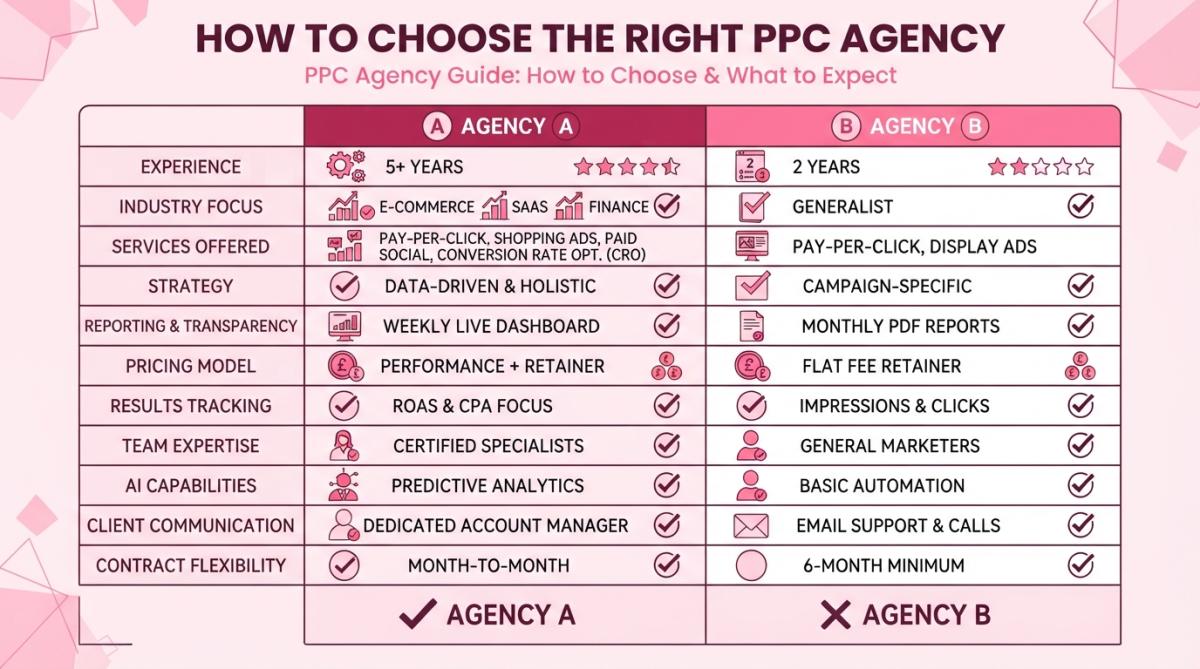
Hiring the wrong ppc agency wastes money and damages your brand. A structured evaluation process reduces risk and ensures you’re selecting an agency aligned with your business goals.
The PPC Agency Evaluation Checklist
Create a weighted scorecard before evaluating agencies. Assign points to criteria that matter most:
Industry Experience (25 points): Does the agency have documented case studies in your specific industry? Ask for references in your exact vertical.
Technical Capability (20 points): Can they manage the platforms you need? Request a technical audit of your current account. Their recommendations should be specific, not generic.
Reporting and Transparency (20 points): Request a sample report. Is it a dashboard dump or a narrative? Ask how often you’ll communicate and whether you have direct access to your Google Ads account.
Team Structure and Continuity (15 points): Who will manage your account day-to-day? What happens if your account manager leaves? Ask about account manager tenure and turnover rates.
Pricing Alignment (10 points): Does their pricing model align with your goals? Avoid agencies that won’t discuss pricing transparently or that require long-term contracts with exit penalties.
Questions That Separate Good Agencies from Great Ones
Ask the ppc agency to walk you through their actual process, not their methodology. "Here’s how we structure accounts for a business like yours. Here’s our keyword research process. Here’s how we test ad copy." If they can’t articulate a clear process, they don’t have one.
Ask about their approach to your specific challenge. Ask how they handle budget constraints and their testing philosophy. A strong answer includes a testing roadmap showing systematic approach, not reactive decisions.
Red Flags and What to Avoid
Avoid agencies that promise guaranteed results. No legitimate ppc agency guarantees a specific ROAS or CPA. Avoid agencies that don’t ask questions about your business before proposing strategy. Avoid agencies that won’t discuss fee structure transparently or that resist discussing ROI expectations. Avoid agencies that don’t provide transparent reporting or restrict your access to your own Google Ads account. Avoid agencies that don’t test and iterate continuously. Avoid agencies that claim expertise in all platforms equally.
The Reference Call: What to Ask
When an agency provides references, ask specific questions: What was your ROAS before and after? How long until you saw improvement? What surprised you about working with this agency? Did they communicate proactively? Would you hire them again?
Ask for references from at least two clients in your industry and one from a different industry. Ask for references from clients with similar budgets to yours.
AI and Automation in Modern PPC Agencies
The PPC landscape is shifting toward automation and AI-driven optimization. The best ppc agencies today use machine learning to predict customer behavior and optimize campaigns at scale.
Modern automation is sophisticated. Google’s Performance Max campaigns use machine learning to optimize across all Google channels simultaneously. Facebook’s Advantage+ campaigns automatically test audiences, placements, and creative variations.
A forward-thinking ppc agency embraces automation, understanding that machines are better at processing data and finding patterns than humans. They use automation for repetitive tasks and focus their expertise on strategy and creative testing.
AI is changing how ppc agencies approach keyword research, ad copy, and landing page optimization. AI tools can analyze competitor ads, identify messaging gaps, and suggest copy variations. They can predict which keywords will convert before you bid on them.
The risk of AI in PPC is over-reliance. Some agencies use AI to completely automate campaign management, reducing human oversight. The best ppc agencies combine machine learning with strategic thinking, creative testing, and business acumen.
Contractual Transparency and Accountability
A contract with a ppc agency should be clear about what you’re getting, what success looks like, and what happens if performance drops.
What to Look for in an Agency Agreement
The contract should specify deliverables. Not vague promises but concrete deliverables: "We’ll manage your Google Ads account, test at least two ad variations per week, optimize keywords and bids daily, provide monthly reporting, and maintain a minimum account structure of X campaigns."
Performance metrics should be defined. What are you measuring success against? ROAS? CPA? Revenue? The contract should specify the baseline and target, plus the timeframe for improvement.
Payment terms matter. Is the fee fixed or variable? When is it due? What happens if you want to pause or cancel? A good ppc agency doesn’t lock you into long-term contracts with exit penalties.
Communication cadence should be outlined. How often will you hear from the agency? What will meetings cover? What’s the process for requesting changes?
Account ownership should be clear. You own your Google Ads account. The ppc agency manages it on your behalf, but you retain ownership and can access it anytime. If you leave, you can take the account with you.
Measuring Success: PPC Audit and Performance Metrics
You can’t optimize what you don’t measure. A good ppc agency measures everything and explains what the numbers mean.
Key Performance Indicators and ROI Tracking
The metrics that matter depend on your business model. An e-commerce brand cares about revenue and profit. A B2B SaaS company cares about qualified leads. A service business cares about bookings. A ppc agency should measure success in your business metrics, not marketing metrics.
Cost per acquisition (CPA) is critical. If your CPA is $50 and your average customer lifetime value is $500, you have a healthy 10:1 ratio. A ppc agency should optimize toward target CPA.
Return on ad spend (ROAS) measures revenue generated per dollar spent on ads. A 2:1 ROAS means for every dollar spent, you generate two dollars in revenue. A 3:1 ROAS is better. But ROAS doesn’t account for profit margins or customer lifetime value. A ppc agency should understand the difference between revenue and profit.
Conversion rate is important but often misleading. A landing page with a 5% conversion rate might be better than one with a 3% conversion rate, but if the 3% page attracts higher-value customers, it might be more profitable. A ppc agency looks at conversion rate in context of customer value.
Quality score is Google’s rating of your ads and landing pages. Higher quality scores mean lower costs and better ad positions. A ppc agency should maintain quality scores above 7/10. Click-through rate (CTR) measures how many people click your ads. Higher CTR usually means better ad copy, but CTR alone doesn’t indicate success. A ppc agency uses CTR as a diagnostic tool, not a success metric.
Choosing a ppc agency is one of the highest-impact decisions a growing brand can make. The right agency compounds your growth, turning ad spend into sustainable profit. Focus on finding a ppc agency that demonstrates clear expertise in your industry, communicates transparently about strategy and results, and ties their success to your revenue growth. The best partnerships align incentives, prioritize ROI, and deliver measurable results.
Frequently Asked Questions
What does a PPC agency do?
A PPC agency manages your pay-per-click advertising across platforms like Google Ads, Bing Ads, and social media channels. They handle keyword research, ad copy creation, bid management, landing page optimization, and continuous campaign optimization to improve your conversion rate and ROI. They also provide analytics and performance reporting to track results.
How much does a PPC agency cost?
PPC agency pricing depends on your ad spend volume, campaign complexity, industry, and the services included. Pricing models vary, some charge a percentage of your ad spend, others use flat fees or performance-based models. To get accurate pricing tailored to your specific needs and budget, contact agencies directly for a custom quote.
What benefits of hiring a PPC agency should I expect?
Key benefits include expert campaign optimization that improves conversion rates, professional ad management that saves internal time, access to advanced tools and analytics, strategic keyword research and bid management, and scalability as your business grows. Agencies bring specialized expertise in landing page optimization, A/B testing, and ROI-driven strategies that often deliver better results than in-house management.
How do I know if a PPC agency is right for my business?
Evaluate agencies based on their experience with your industry, transparent reporting practices, clear contractual terms, and willingness to answer detailed questions about strategy. Ask for case studies, references, and specifics on how they'll improve your current performance. Red flags include vague promises, pressure to sign long contracts, or reluctance to discuss metrics and accountability.
What questions should I ask a PPC agency before hiring?
Ask about their experience with your industry and business model, how they approach PPC keyword research and account structure, what tools they use, how they report results, their typical contract length and exit terms, and specific examples of how they've improved ROAS for similar clients. Request clarity on fee structure, who manages your account day-to-day, and how they handle communication.
What are red flags when choosing a PPC agency?
Watch for agencies that guarantee results, avoid discussing your specific metrics or goals, pressure you into long-term contracts without clear performance benchmarks, use boilerplate strategies without customization, lack transparency in reporting, or disappear after initial setup. Also be cautious if they can't explain their approach to bid management, landing page optimization, or A/B testing in detail.
Should I hire a PPC agency or manage campaigns in-house?
In-house management offers direct control and lower ongoing costs but requires hiring skilled staff, investing in tools, and dedicating significant time to stay current with platform changes. Agencies provide expertise, scalability, and access to advanced tools, but involve higher fees and less direct control. Choose based on your budget, team capacity, and whether you have the expertise to optimize campaigns for conversion rate and ROI.
This article was written using GrandRanker