Craftcloud case study
See how we rebuilt Craftcloud’s paid engine with a funnel-true structure and message-market-fit creative, lifting ROAS and cutting CAC.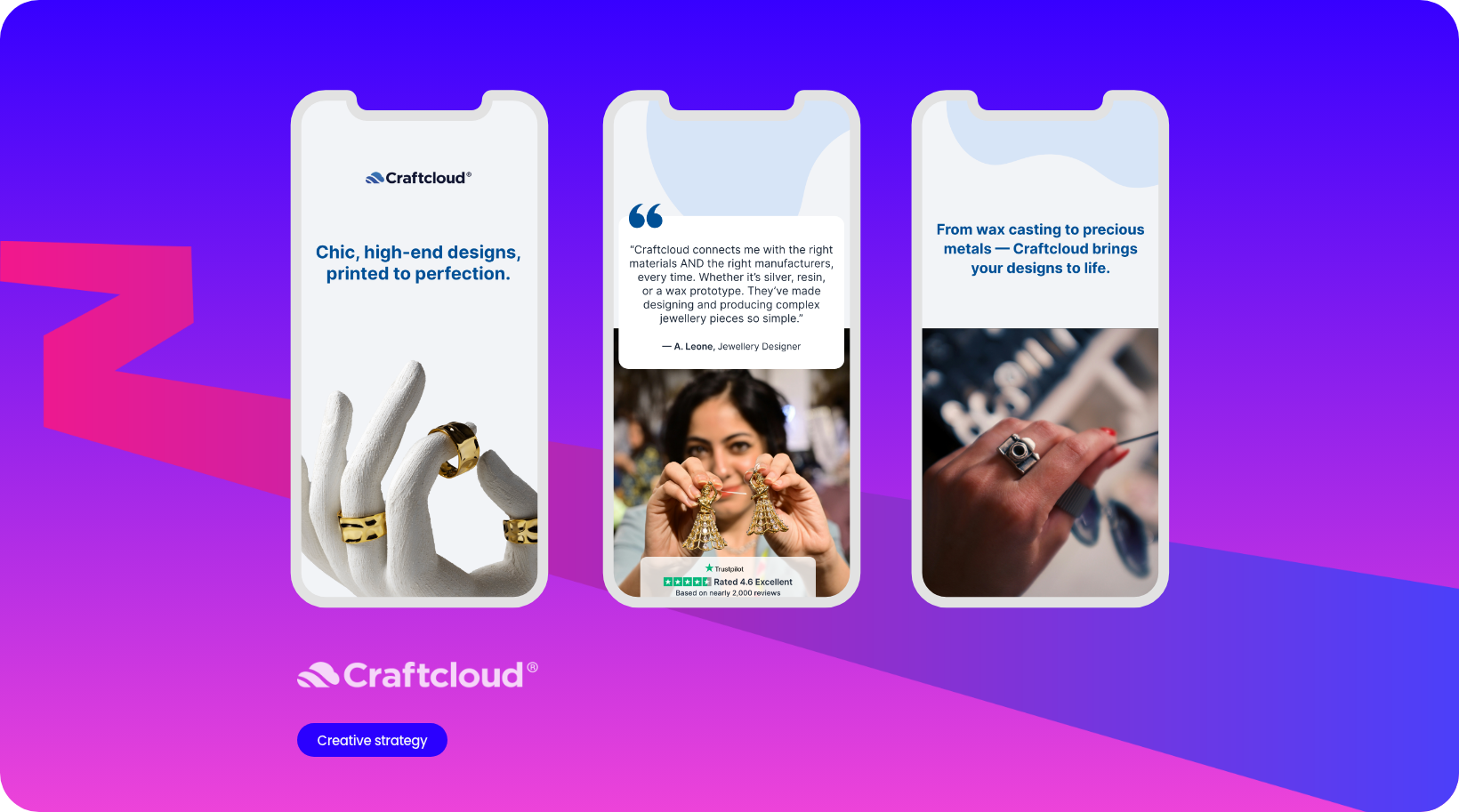

-
+25%
Uplift in ROAS, operating in the 7–8 range
-
-15%
CAC
-
+12%
Revenue
-
+40%
Budget increase at target efficiency
How we delivered breakthrough performance for Craftcloud—lifting ROAS 25% and cutting CAC 15%
Craftcloud entered the market with a powerful proposition for a very specific set of buyers, but the creative and account structure didn’t reflect that. Ads leaned on generic product visuals and broad targeting, with traffic objectives and overlapping audiences that blurred intent. Bottom of the funnel was undercooked, and lookalikes soaked up budget without returns. Performance was capped, and engagement lagged.
They came to us to scale Meta profitably. What they really needed was a complete rethink of messaging, funnel architecture and a creative system that spoke directly to engineers, indie designers, makers and product teams—in their terms, with proof around tolerances, lead times, materials and price transparency.
We created a research-driven creative and performance strategy for Craftcloud, a marketplace that connects customers to a vetted global network for on-demand manufacturing. We rebuilt the account around intent, installed a rapid testing cadence and shifted budgets towards the audiences doing the heavy lifting. Creative moved from generic shots to problem/solution UGC, comparison carousels and testimonial proof—paired with soft CTAs and sequenced retargeting—so the message, the media and the moment of intent finally worked as one.
Craftcloud wanted efficient, defensible growth on paid social. Commercially, the mandate was clear: grow revenue while keeping Meta ROAS in the 7–8 band as scale increased.
Under the surface, three bottlenecks held performance back:
- Architecture that diluted intent. Awareness campaigns ran on traffic or landing-page-view objectives; audiences overlapped; BOF was either missing or folded into MOF. Without a dedicated retargeting engine, frequency rose without a matching lift in conversions.
- Creative volume and cadence below learning needs. Ads ran for months without refresh, stalling discovery of hooks, formats and CTAs that lift CTR, CVR and CPA at each stage.
- Rising category demand not converted by paid social. The market was expanding and competitor social output was thin, but without audience-to-message fit and a clean structure, Craftcloud couldn’t capitalise.
Our approach was pragmatic and sequenced: fix account structure, align audiences to intent, install a creative operating system and let Meta work as one system from top to bottom of the funnel.
1) Rebuild the account around intent and control
- Awareness: one lightweight, super-broad campaign to sustain halo effects.
- Top of funnel: four campaigns by cohort—industrial clientele, indie designers and startups, hobbyists, academics and educators.
- Middle of funnel: brand engagers and website visitors focused on trust and education.
- Bottom of funnel: recent abandoners and lapsed abandoners with urgency and risk-reversal.
- CRM and retention: recent and lapsed purchasers with frequency caps to protect LTV.
We enforced exclusions between stages to avoid cannibalisation, safety-checked daily and moved budgets on a two-week look-back so spend tracked incremental profit, not habit. In parallel, a four-week stabilisation plan fixed audience overlap, set conversion objectives, split geographies, refreshed creatives every one to two weeks and tightened placement mix.
2) Map audiences to messages that remove friction
Each cohort saw benefits in their own terms:
- Industrial clientele: precision, scale, vetted network, instant quoting.
- Indie designers and startups: launch without a factory—no MOQs, rapid iteration.
- Hobbyists: better finish and strength than desktop prints.
- Academics and educators: fast, accurate prints for teaching and research.
Bottom-of-funnel copy cut anxiety to the bone: “Instant quotes. No mark-ups. No nonsense.” with turnaround clarity, global shipping and third-party proof.
3) Install a creative operating system, not a one-off refresh
To win on social, we needed controlled volume and fast learning:
- Dedicated test budget of 20–30% with minimum per-asset spends to reach significance.
- Standalone test campaign, promote winners into BAU and cut losers quickly.
- Centralised asset library and naming conventions, a shared test backlog and bi-weekly creative reviews.
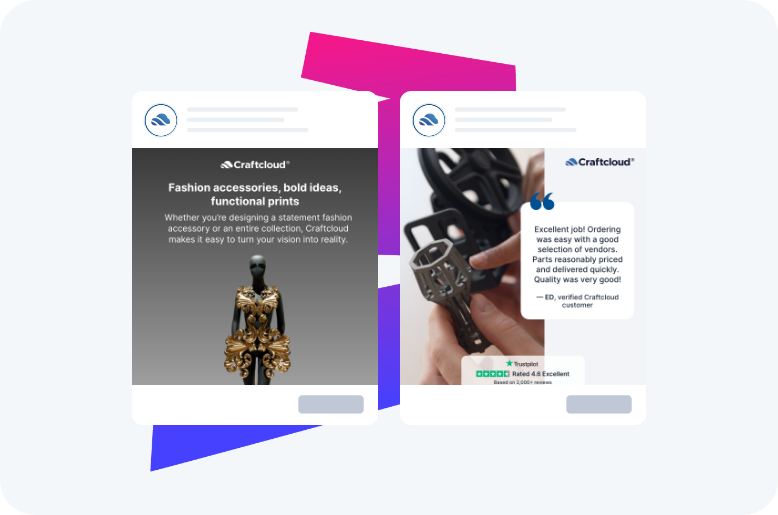
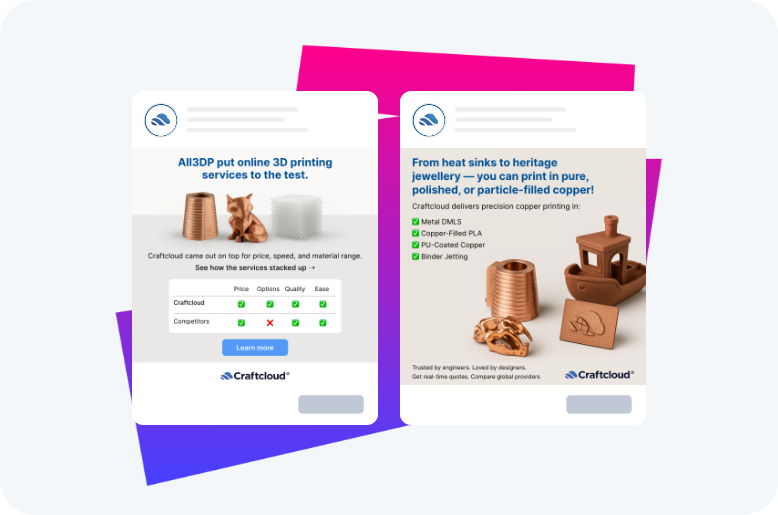
The asset roadmap matched how people evaluate complex services: time-lapse demos, case-study videos, comparison charts, configurators, customer-success galleries and expert explainers—mapped across awareness, consideration and conversion.
We grounded creative strategy and messaging in market reality through review mining, Reddit analysis and competitor teardowns, focusing on speed and efficiency, quality and precision, transparent pricing and pain points like inconsistent quality or delays.
4) Creative diversity to unlock new pockets
We launched UGC testimonial variants for underserved cohorts—jewellery and fashion designers, academic institutions, medical engineers focused on prosthetics and device housings, aerospace hobbyists and pop-culture prop makers—each with domain-specific proof and tailored CTAs. We tested within the standing test budget and promoted winners into BAU.
Within the first operating cycle, the programme shifted from isolated strengths to a compounding system.
Headline commercial impact
- 25% overall ROAS uplift
- 15% drop in CAC as higher-quality traffic flowed into MOF and BOF.
- 12% revenue growth delivered on disciplined, channel-true scaling.
- 40% uplift on BOF budget, while maintaining target efficiency, unlocking incremental orders without discounting.
Audience and funnel economics
- Retargeting efficiency at scale. Splitting BOF by intent (product viewers, carts, checkouts) and sequencing creative—UGC, features carousel, testimonial—kept frequency in check and preserved efficiency while scaling.
- Prospecting quality up. Interest-based cohorts became the primary cold engine after pausing weak lookalike seeds and rebuilding from recent high-value buyers. Broad remained viable only when paired with winning UGC, proving creative can pre-qualify better than brittle micro-segmentation.
- Throughput improved across the funnel. Top of funnel produced higher-intent clicks, mid-funnel assets built trust faster and bottom of funnel converted more of the demand we created, without resorting to blunt discounting.
Creative drivers of growth
- UGC problem/solution videos with question-led hooks delivered 3× higher engagement than static and lifted downstream conversion.
- Features carousels mapped capability to outcome and served as the explain layer.
- Video testimonials closed the loop for evaluators.
- Soft CTAs such as “Learn more” beat hard CTAs at top of funnel, improving click quality and eventual conversion rate.
- We retired generic product shots and text-heavy statics, consolidating spend into winners and near-variants.

Related Success  stories

The Gut Stuff case study
We transformed The Gut Stuff’s paid media strategy with new funnels, optimised keywords, fresh assets, and precise audience targeting. This resulted in a 100% ROAS boost on Meta, a 48% sales increase via Google Ads, and a 117% drop in CPA.
How did we do it?

Empress Mimi case study
Empress Mimi's revenue soared 89%! Catchy subjects, templates, and strategic tweaks. Read our case study for the full story!
How did we do it?
Where’s next for your brand?
No matter where you are in your marketing journey, our dazzling team of specialists will keep you moving, show you how to grow, and help you actualise the vision you’ve always secretly had for your brand.